Intro to Bayesian Statistics

Intro to Bayesian Statistics


That’s the name of a whole course!


but here we go

Likelihood is kinda awkward

We maximize

\[ \mathbb{P}(\text{data} \mid \text{model params}) \]

and that tells us what parameters best fit the data


“find the parameters that maximize the probability of the data given those parameters”


to understand uncertainty in parameter estimates we have to do a somewhat convoluted comparison to a \(\chi^2\) distribution


but likelihood is important, and it is a natural way to think about models because it flows from how data would be generated from a given model

Likelihood is kinda awkward

It just might be easier to interpret if we could flip the conditional

\[ \mathbb{P}(\text{model params} \mid \text{data}) \]


we can read this as just “what is the probability of these parameters given the data?”

Bayes

This probability has a special name in Bayesian statistics

\[ \mathbb{P}(\text{model params} \mid \text{data}) \]

it is the posterior

it automatically encodes information about uncertainty:

we can ask about the probability of any parameters, not just the most likely

and we are often most interested in this question: how likely is my model given the data.

To get there with the likelihood we have to use a null hypothesis test and ask “how likely is my model inference if the real model is null?”

but we can get the posterior from the likelihood! (with a little math)

Bayes

This is Bayes’ Theorem, where Bayesian statistics gets its name

\[ \mathbb{P}(\theta \mid \text{data}) = \frac{\mathbb{P}(\text{data} \mid \theta) \mathbb{P}(\theta)}{\mathbb{P}(\text{data})} \]


the numerator is the likelihood times something new:

the prior \(\mathbb{P}(\theta)\)


the prior \(\mathbb{P}(\theta)\) represents our prior assumptions or knowledge about the value of the parameter(s) \(\theta\)

The prior

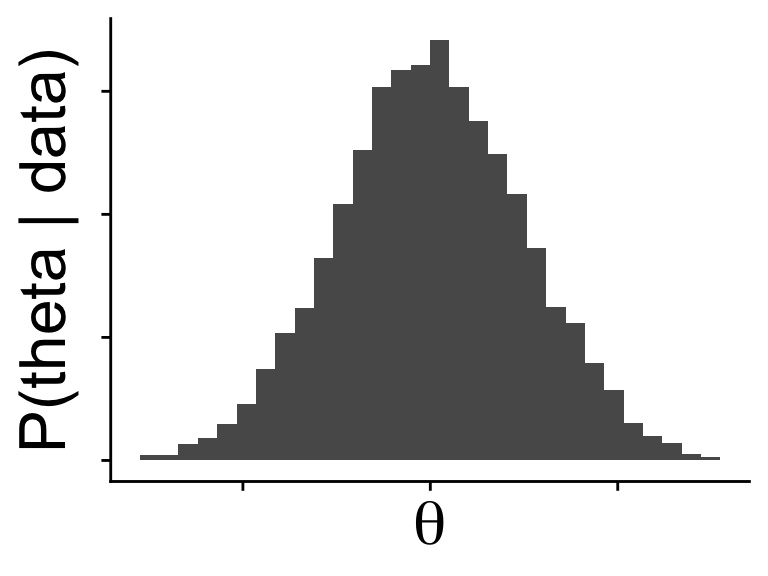
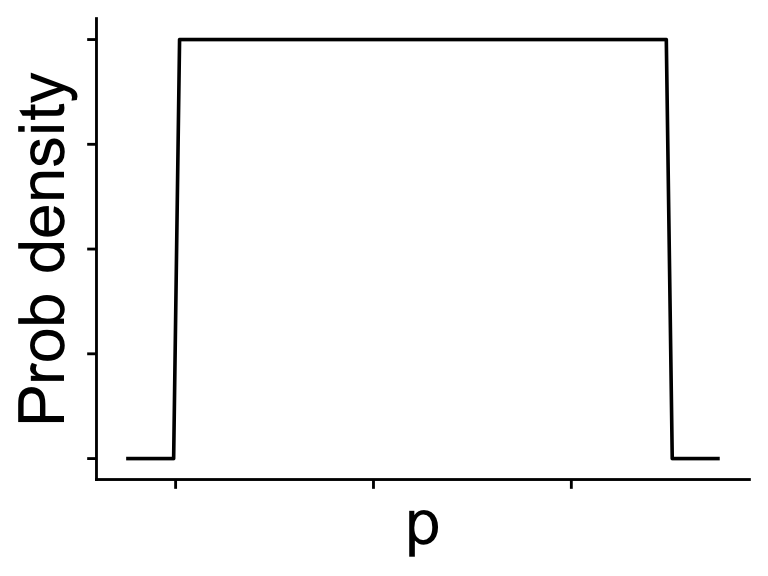
Most often we want a flat prior, one that tries to make as few assumptions as possible

That’s easy when our parameter is naturally bounded like the binomial \(p\)

But more difficult with unbounded \((-\infty, \infty)\) parameters like a slope \(\beta\)

We do our best by making distributions as broad as possible like \(\mathcal{N}(\mu = 0, ~\sigma = 1,000)\), which is effectively flat

\[ \begin{aligned} \mathbb{P}(0 < \beta < 100) &= 0.0398278 \\ \mathbb{P}(100 < \beta < 200) &= 0.0394319 \end{aligned} \]

But if we had genuine information about a realistic range of parameter values, a prior allows us to use that

Bayes

If the posterior is easier to interpret, why don’t we do Bayesian statistics more often?

\[ \mathbb{P}(\theta \mid \text{data}) = \frac{\mathbb{P}(\text{data} \mid \theta) \mathbb{P}(\theta)}{\mathbb{P}(\text{data})} \]

  • the prior is a sticking point for some
  • but the real issue is: the denominator \(\mathbb{P}(\text{data})\) is a challenge
  • what does it even mean?!

The “probability of the data”

\(\mathbb{P}(\text{data})\) is the sum of \(\mathbb{P}(\text{data} \mid \theta)\) for all possible model parameterizations

\[ \mathbb{P}(\text{data} \mid \text{this } \theta) + \mathbb{P}(\text{data} \mid \text{that } \theta) + \cdots \]

but we can’t actually take a sum like this (it would be infinite) so formally

\[ \mathbb{P}(\text{data}) = \int_\theta \mathbb{P}(\text{data} \mid \theta) \]

The “probability of the data”

This “sum”

\[ \mathbb{P}(\text{data}) = \int_\theta \mathbb{P}(\text{data} \mid \theta) \]

can be \(\leq 1\) (the data are not guaranteed under our model)

and outside of a few special cases it is impossible to calculate in closed form

but it is extremely important because without it the posterior \(\mathbb{P}(\theta \mid \text{data})\) is not a proper probability, it could be \(> 1\)

So how do we get the posterior?

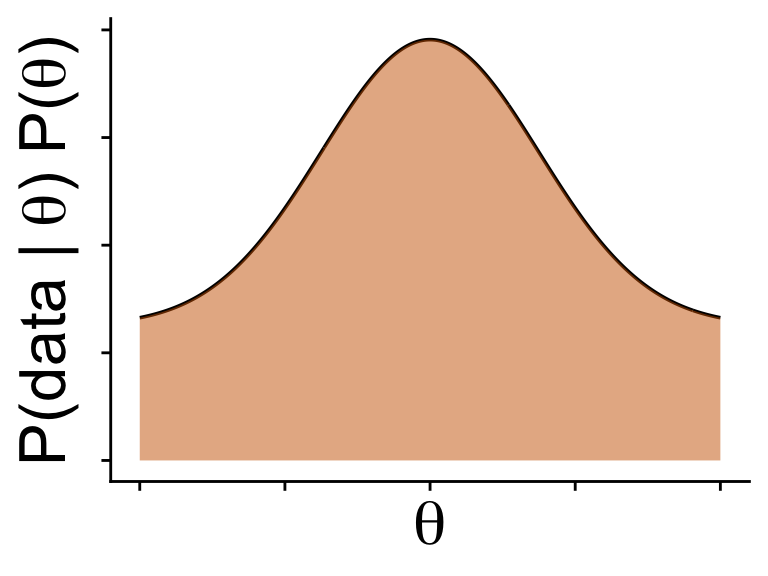
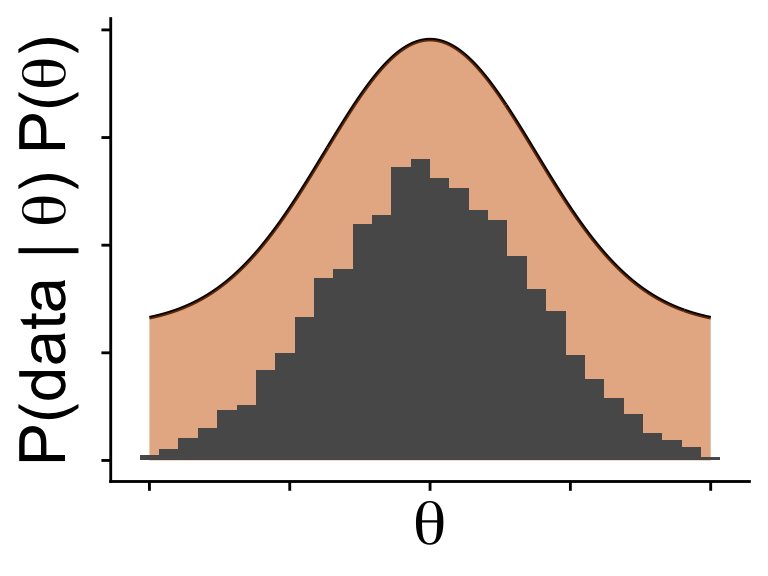
Even though we typically don’t know \(\mathbb{P}(\text{data})\) to normalize the posterior, we know the shape of the posterior

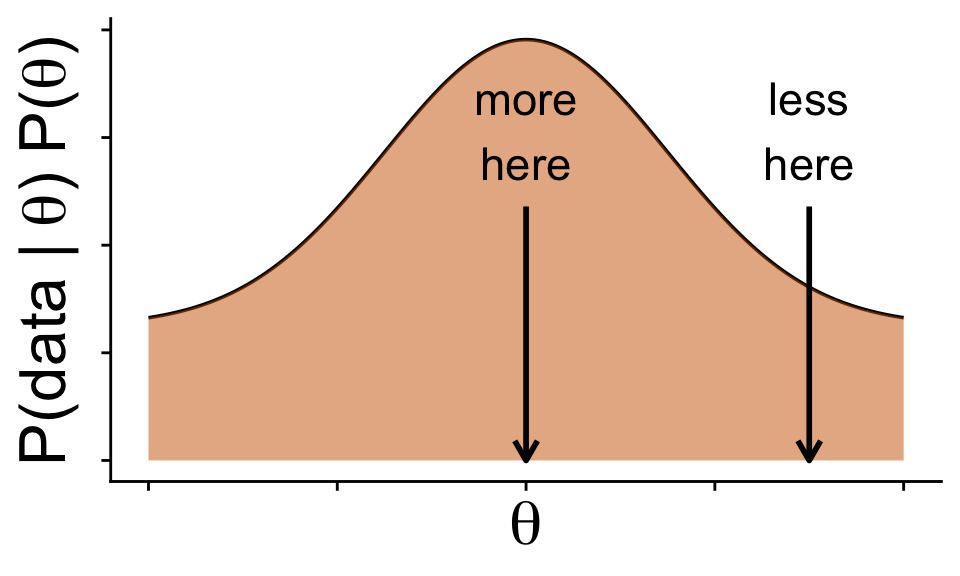
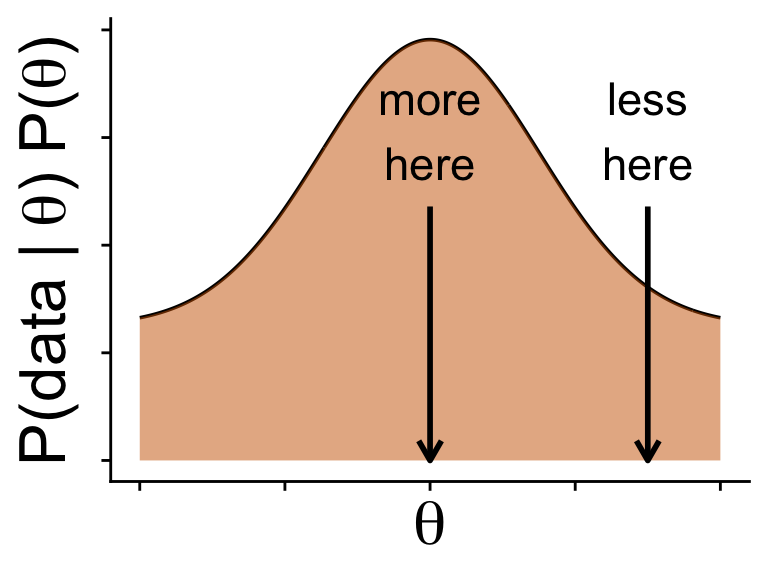
\(\mathbb{P}(\text{data} | \theta) \mathbb{P}(\theta)\) gives the shape

  • does not sum to 1 (not a proper probability)
  • but does show regions where probability should be higher and lower
  • for a single value of \(\theta\) we always know \(\mathbb{P}(\text{data} | \theta)\) and \(\mathbb{P}(\theta)\)

So how do we get the posterior?

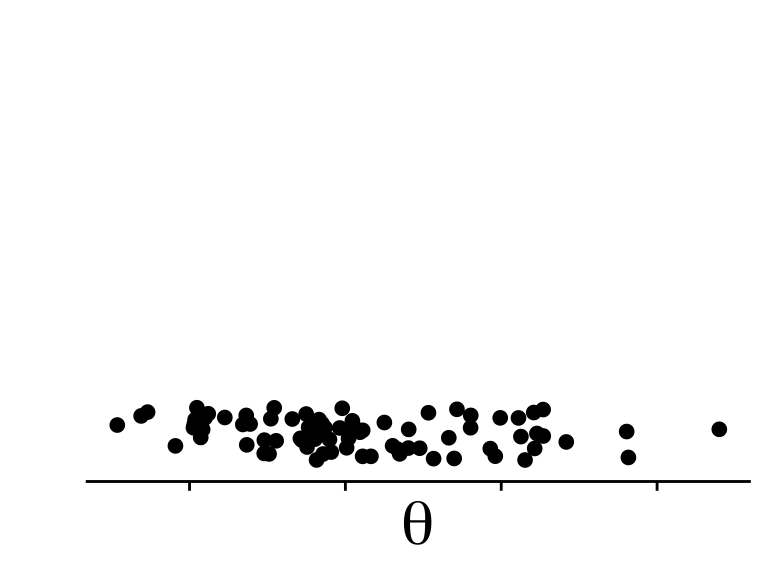
Use the shape of the posterior \(\mathbb{P}(\text{data} | \theta) \mathbb{P}(\theta)\) to draw a random sample consistent with the posterior

  • Monte Carlo (MC) can do this without a proper \(\mathbb{P}(\theta \mid \text{data})\)
  • by sampling values of \(\theta\) in proportion to height the of \(\mathbb{P}(\text{data} | \theta) \mathbb{P}(\theta)\)

So how do we get the posterior?

Use the shape of the posterior \(\mathbb{P}(\text{data} | \theta) \mathbb{P}(\theta)\) to draw a random sample consistent with the posterior

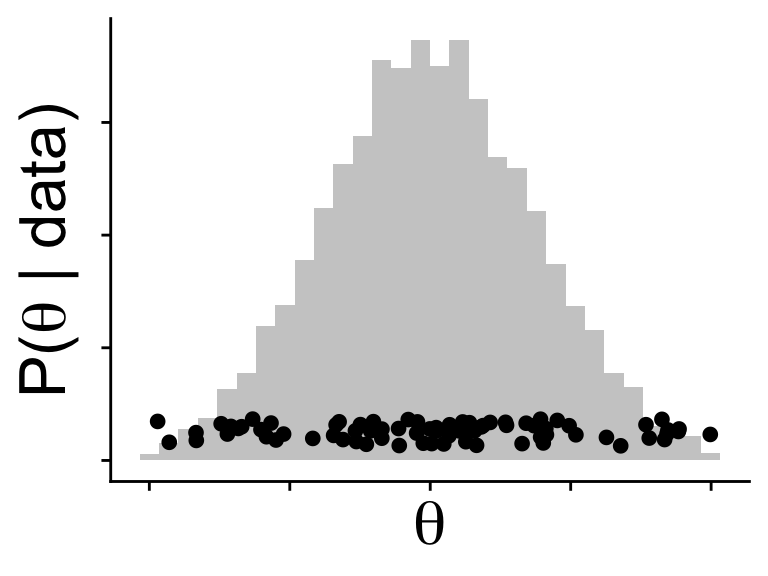
Sampling proportionately to \(\mathbb{P}(\text{data} | \theta) \mathbb{P}(\theta)\)

Yields a sample
of \(\theta\)

That looks like it came from \(\mathbb{P}(\theta \mid \text{data})\)

Markov Chain Monte Carlo (MCMC)

MCMC is the method of choice for this task

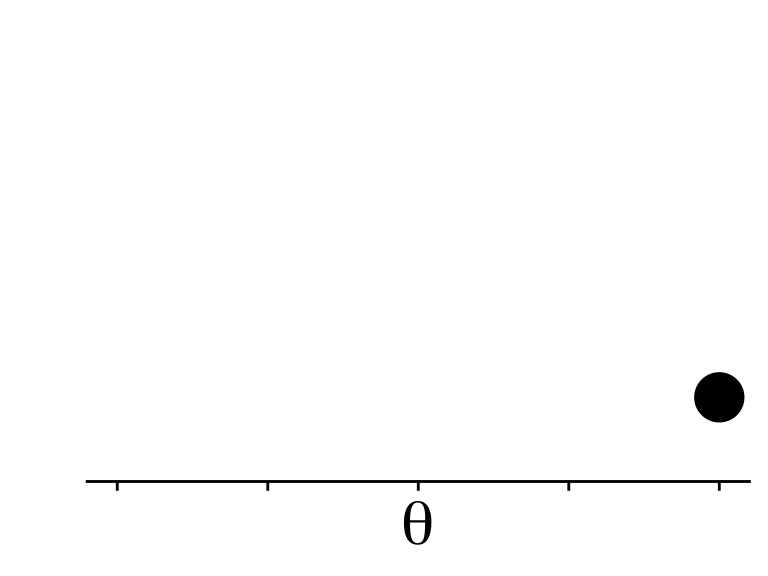
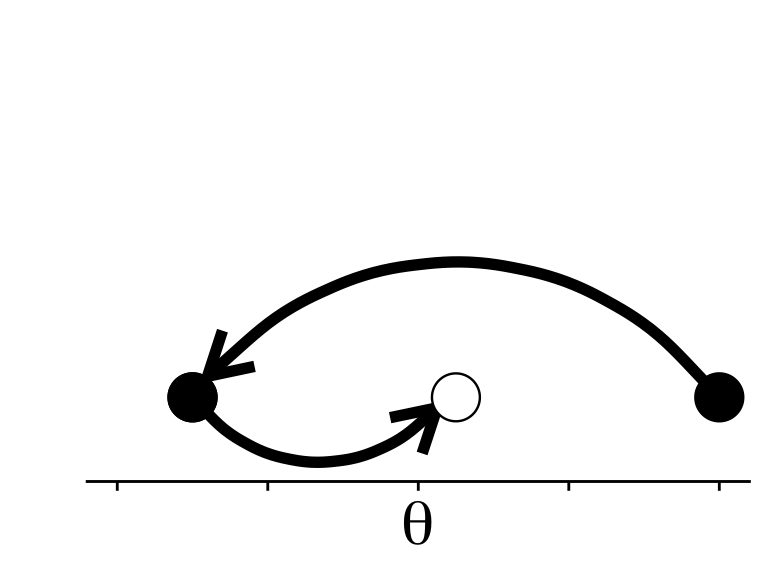
Start with an initial
value for \(\theta\)

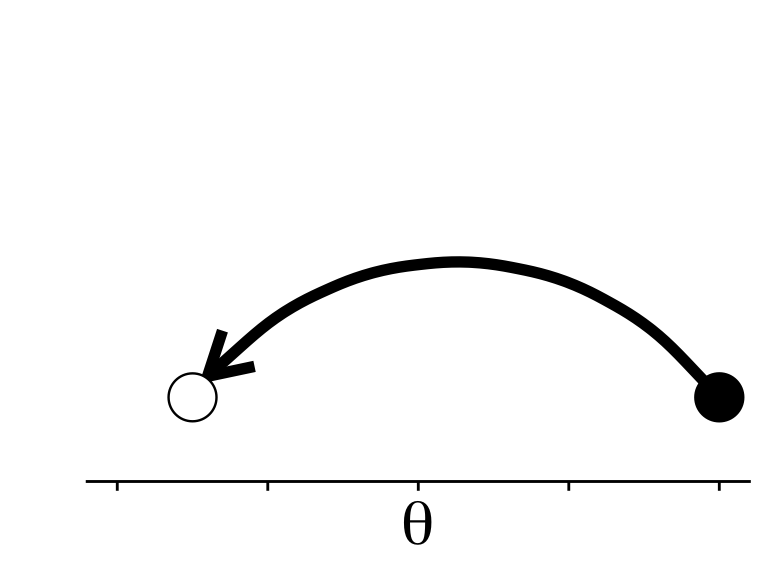
Somehow propose a new value using \(\mathbb{P}(\text{data} \mid \theta) \mathbb{P}(\theta)\)

Markov Chain Monte Carlo (MCMC)

MCMC is the method of choice for this task

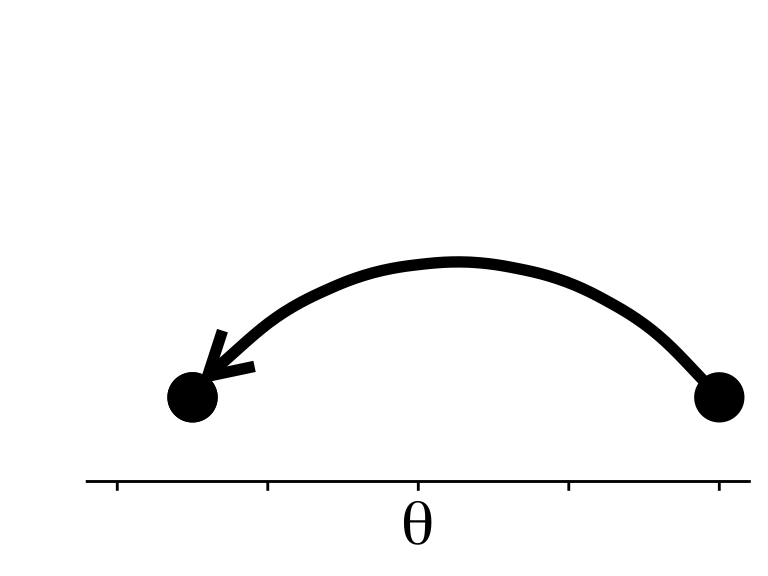
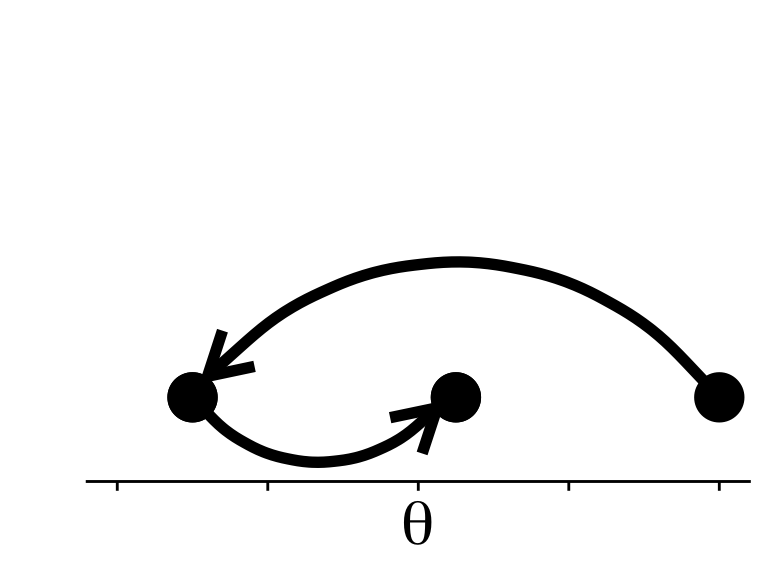
Repeat! with new value
of \(\theta\) as starting point

Somehow propose a new value using \(\mathbb{P}(\text{data} \mid \theta) \mathbb{P}(\theta)\)

Do that enough and we get a sample from the posterior without ever knowing the equation for \(\mathbb{P}(\theta \mid \text{data})\)

Markov Chain Monte Carlo (MCMC)

MCMC is the method of choice for this task

Repeat! with new value
of \(\theta\) as starting point

Do that enough and we get a sample from the posterior…

…without ever knowing the equation for \(\mathbb{P}(\theta \mid \text{data})\)

Markov Chain Monte Carlo (MCMC)

Common MCMC algorithms include

  • Gibbs sampler
  • Metropolis-Hastings
  • random walk Metropolis
  • Hessian Monte Carlo
  • No-U-Turns (NUTS)

NUTS is what the software Stan uses, which is under the hood of the R code we’ll use

No-U-Turns algorithm

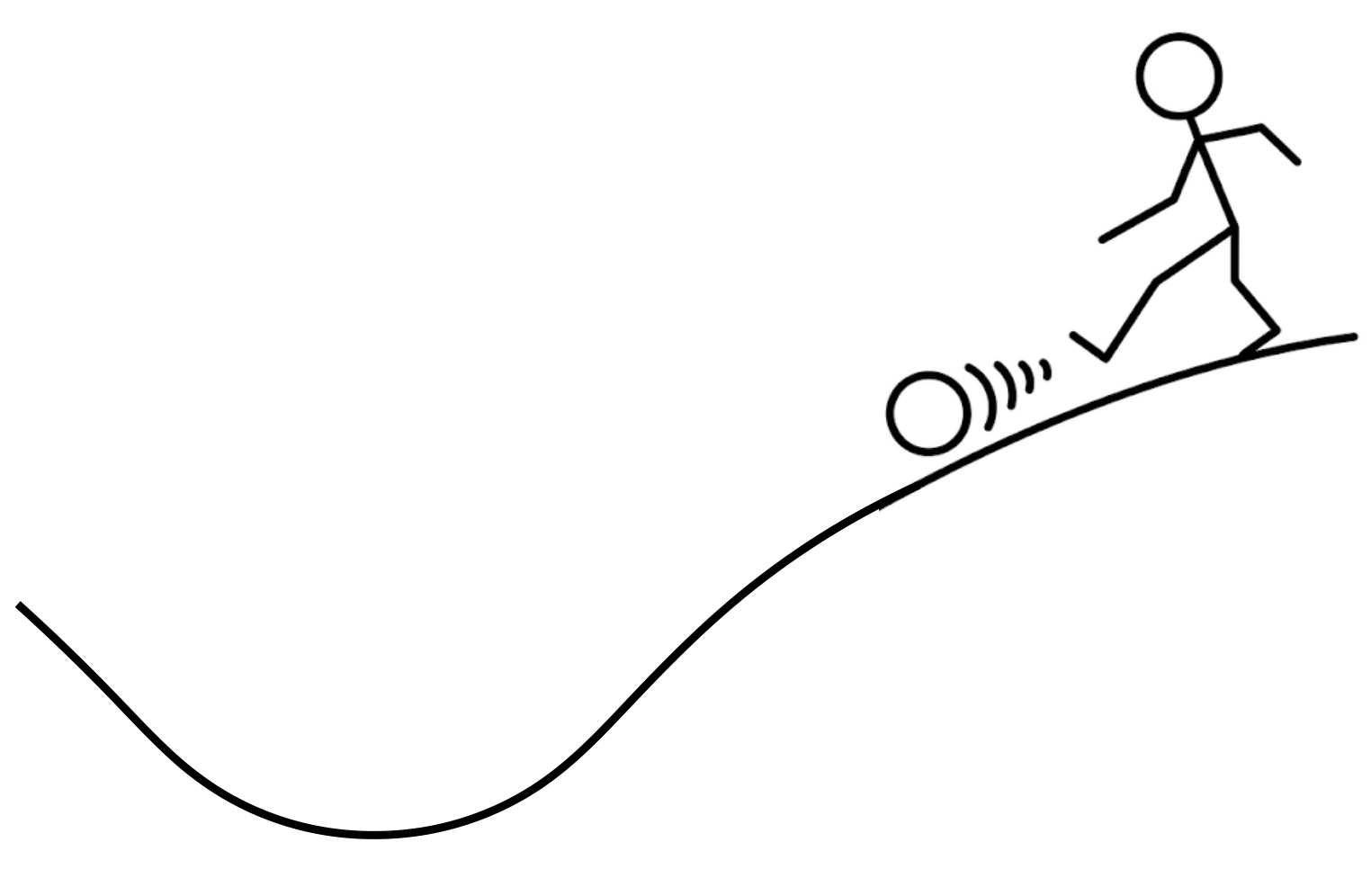
Imagine a kid kicking a ball in a hilly landscape

most of the time, the ball ends up at the bottom of a hill

No-U-Turns algorithm

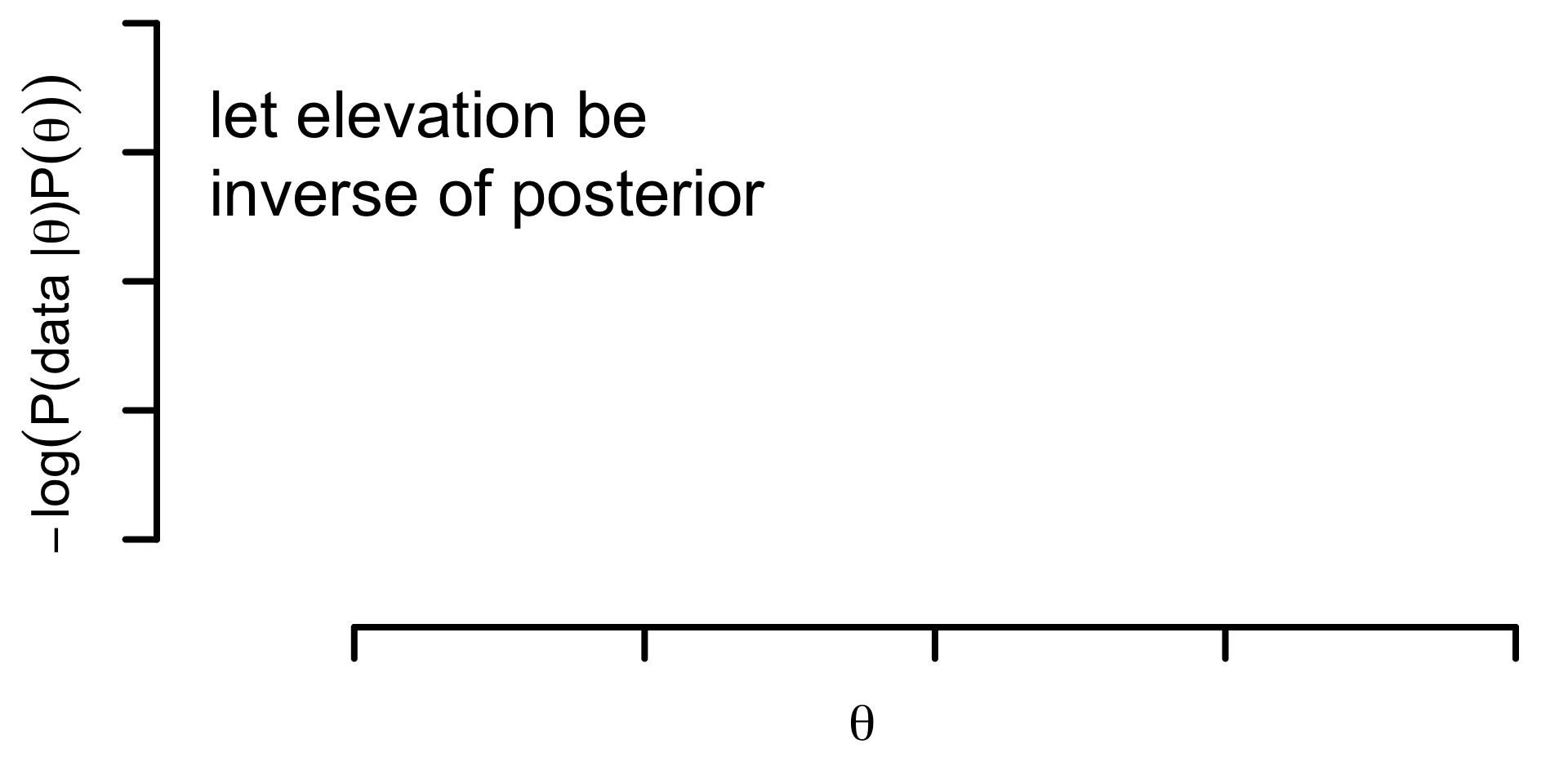
A ball moving around the \(-\log(\mathbb{P}(\text{data} \mid \theta) \mathbb{P}(\theta))\) landscape according to the laws of physics is basically Hamiltonian MC

No-U-Turns just makes HMC more computationally efficient

No-U-Turns algorithm

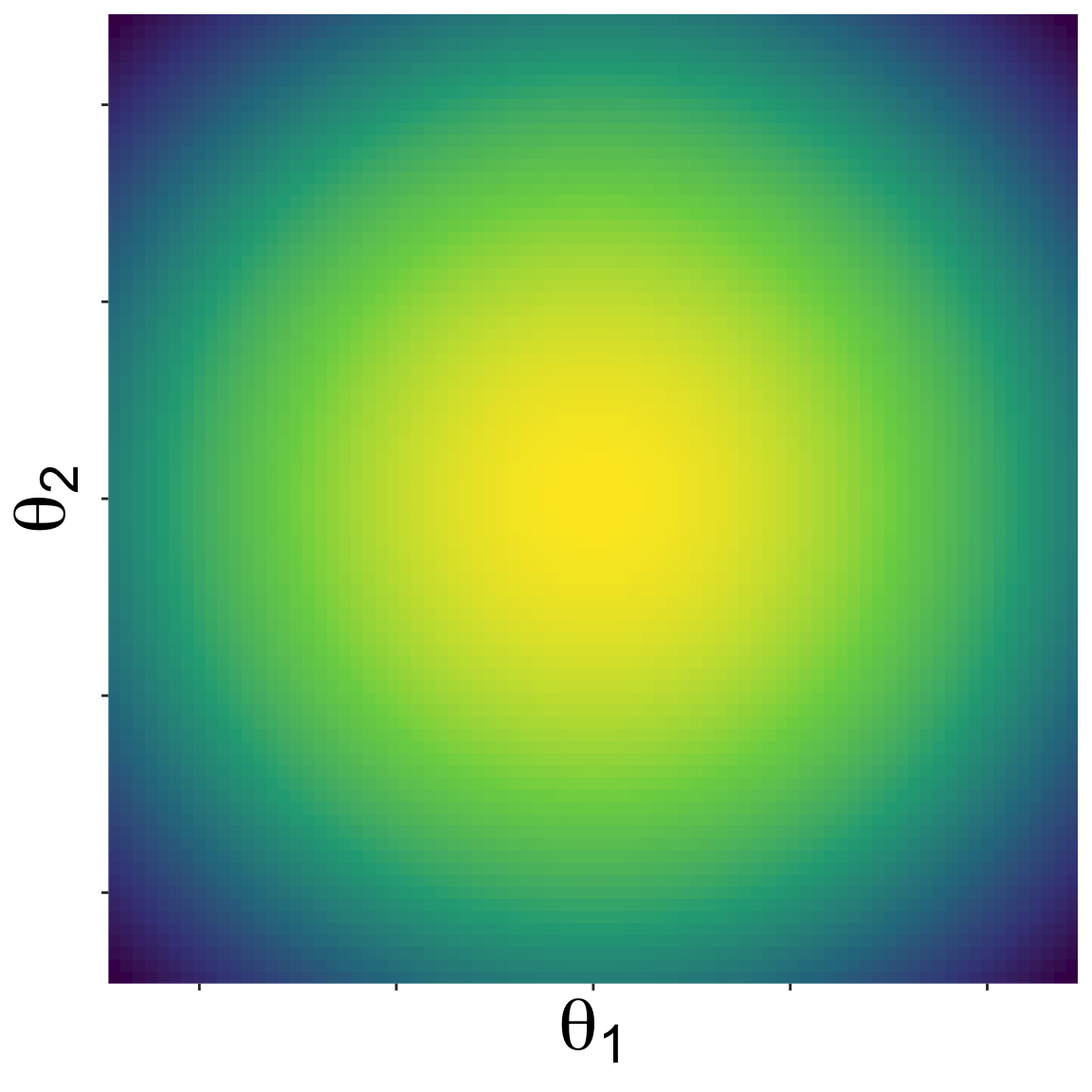
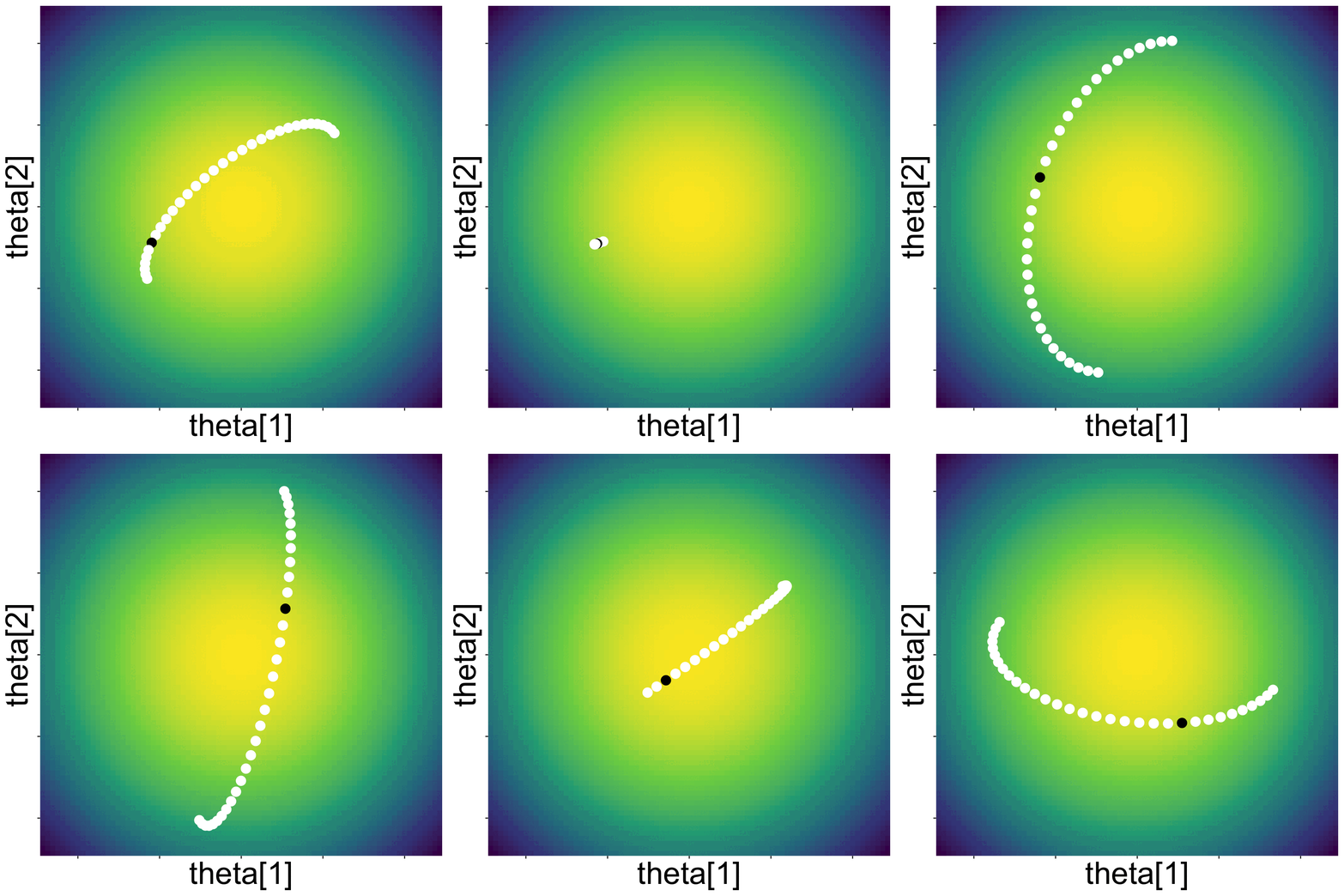
Here is a landscape with two parameters

No-U-Turns algorithm

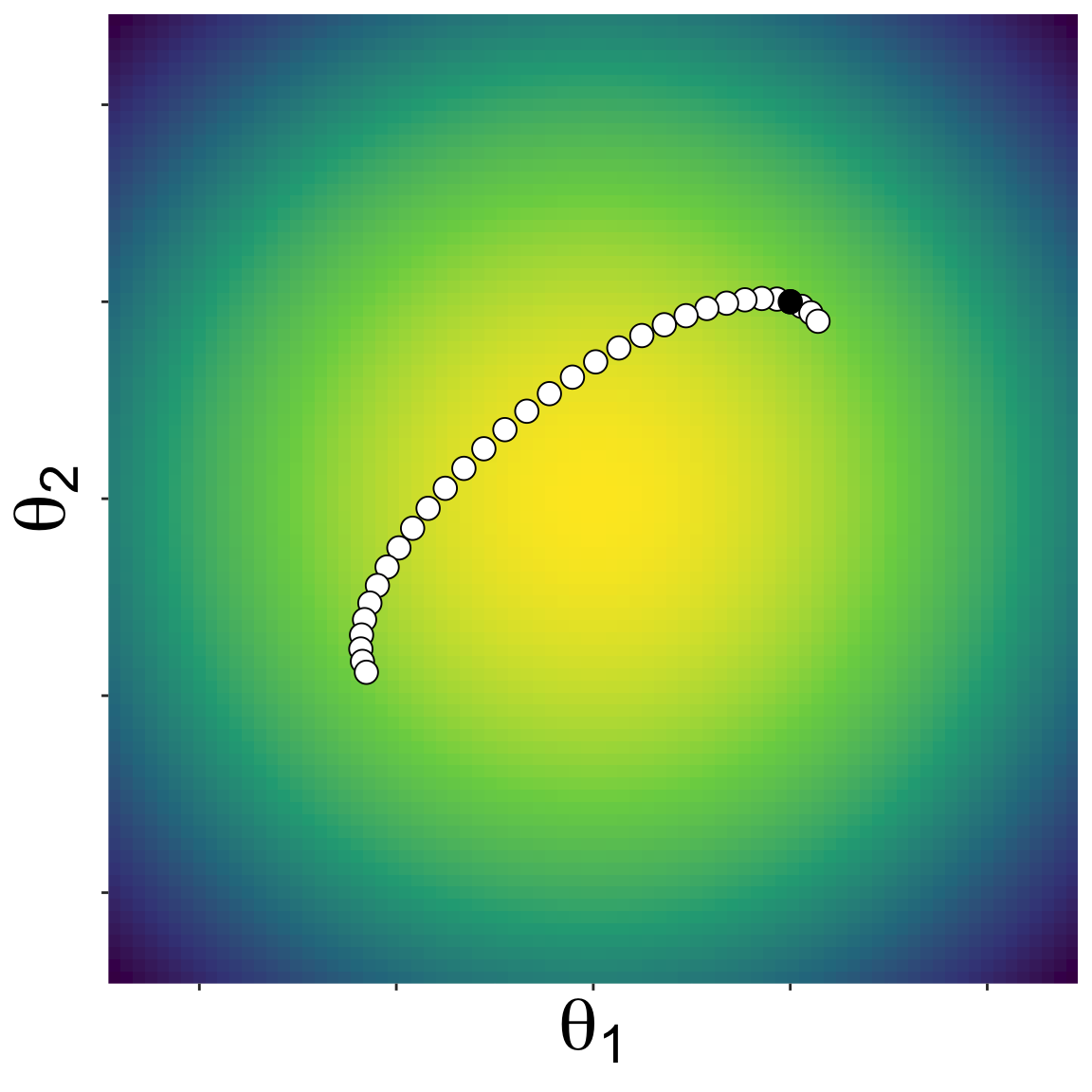
Starting from some initial location, NUTS proposes new parameter values by kicking a ball and seeing where it rolls on the landscape

No-U-Turns algorithm

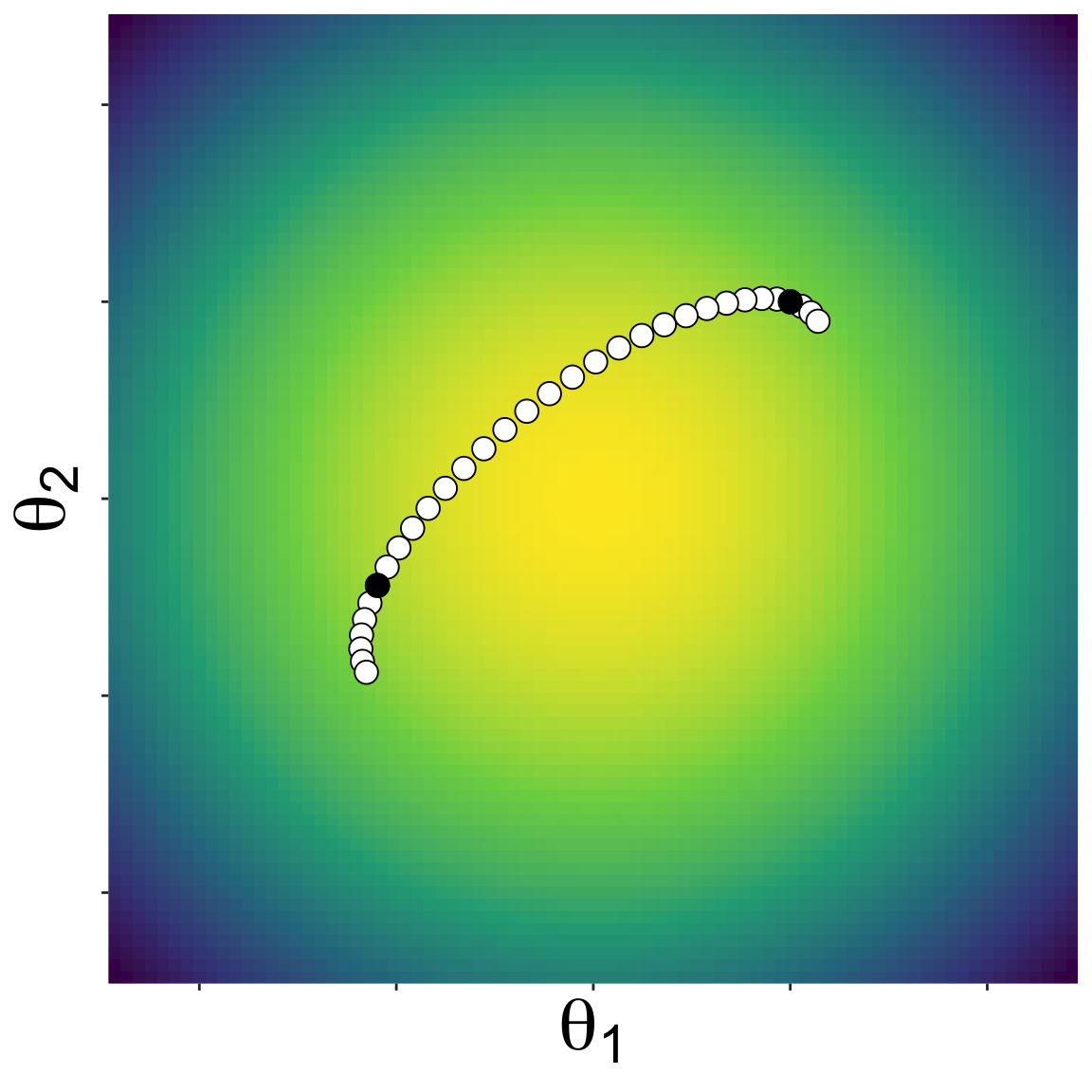
A new set of parameter values along the path of the ball is randomly choosen, and the algorithm repeated

No-U-Turns algorithm

Eventually a sample of the posterior emerges

Package brms makes it easy for us

Despite the complexities of how this works under the hood, brms will make it feel familiar
library(brms)

x <- runif(100, 0, 1)
mu <- exp(-2 + 4 * x)
y <- rpois(length(x), mu)
dat <- data.frame(x, y)

m <- brm(y ~ x, data = dat, 
         family = poisson(), 
         prior = c(prior(normal(0, 1000), class = Intercept),
                   prior(normal(0, 1000), class = b)))

Package brms makes it easy for us

Despite the complexities of how this works under the hood, brms will make it feel familiar
# see the fixed coefficients
fixef(m)
           Estimate Est.Error      Q2.5     Q97.5
Intercept -2.379676 0.3075657 -2.993868 -1.784806
x          4.464150 0.3727007  3.750129  5.189482

We’ll get deep into this in the labs!

Bayesian statistics for the pragmatist

  • there are big philosophical differences between Bayesian and “frequentist” statistics
  • no need to go there
  • and although the posterior probably is how we think about science
  • practically speaking the methods of frequentist statistics are computationally easier
  • however, there are some models that can only be fit with Bayesian methods (as we will soon see)