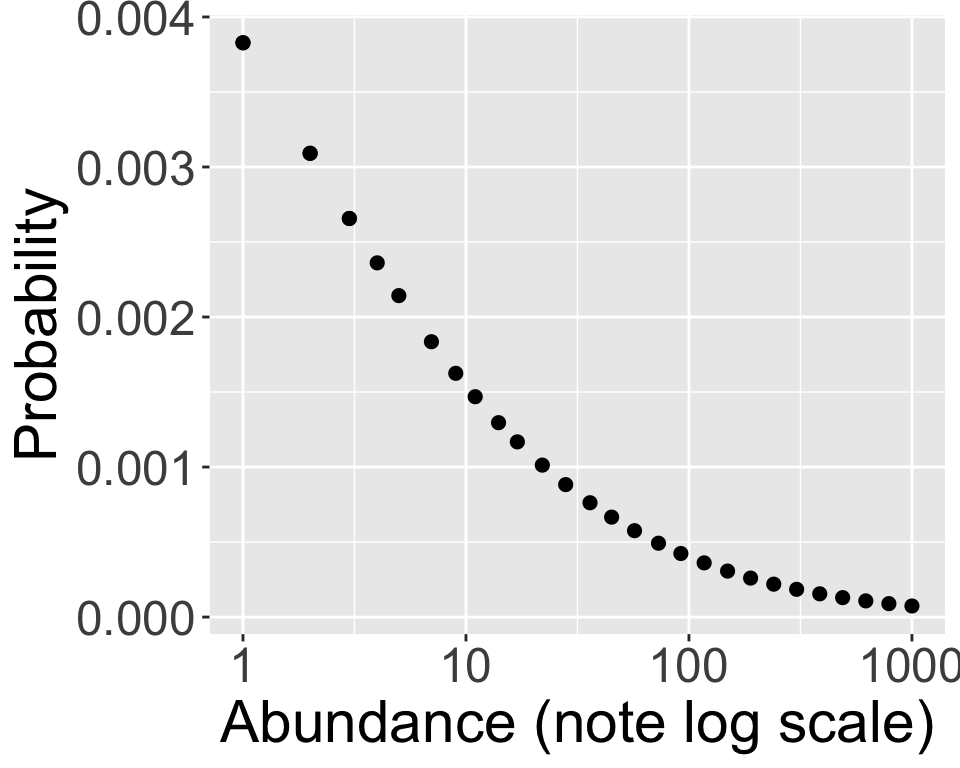
Ecology has spent a long time thinking about the probability distribution of abundances
The shape of the SAD
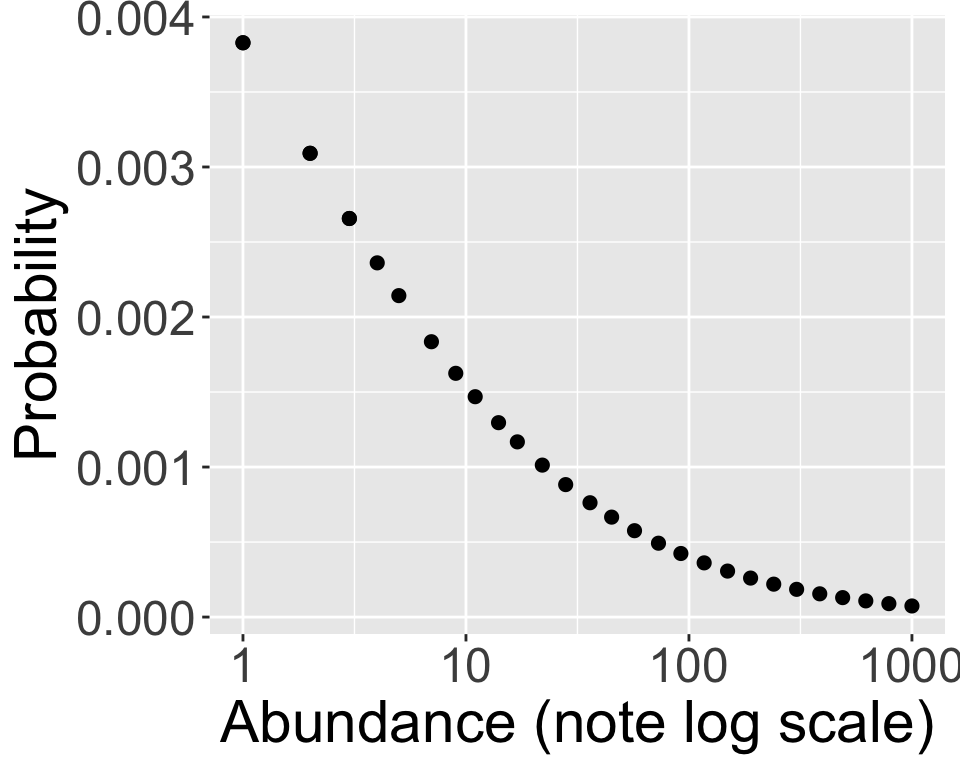
Ecology has spent a long time thinking about the probability distribution of abundances
Most species are rare

But perhaps singletons are not the most frequent
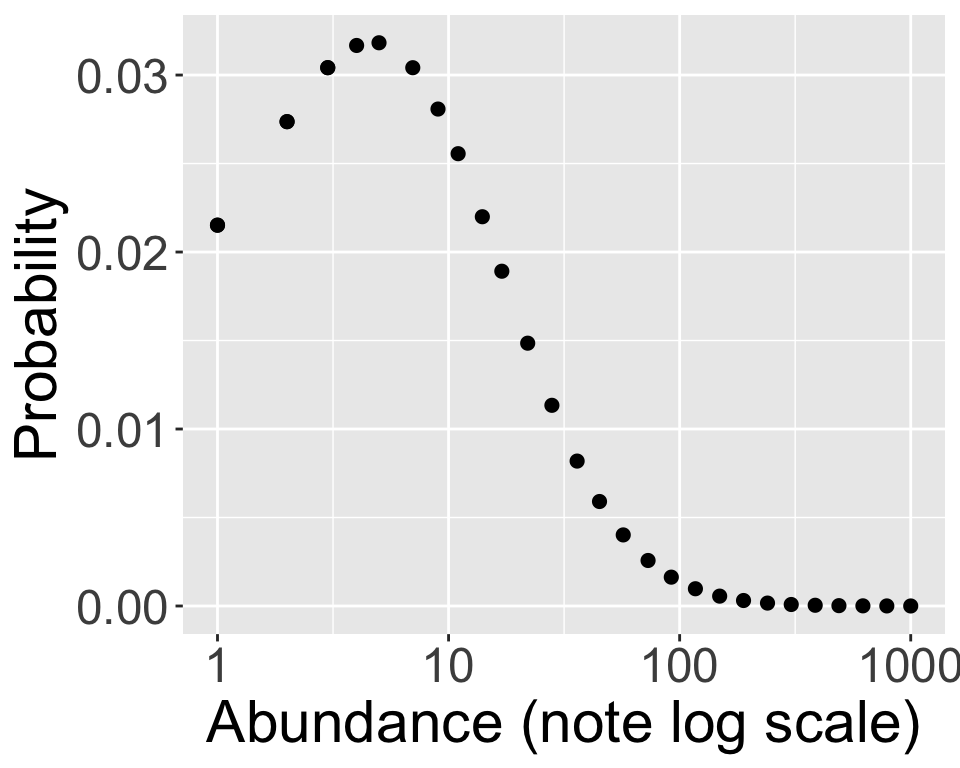
Ecology has spent a long time thinking about the probability distribution of abundances
Log series distribution
Log normal distribution
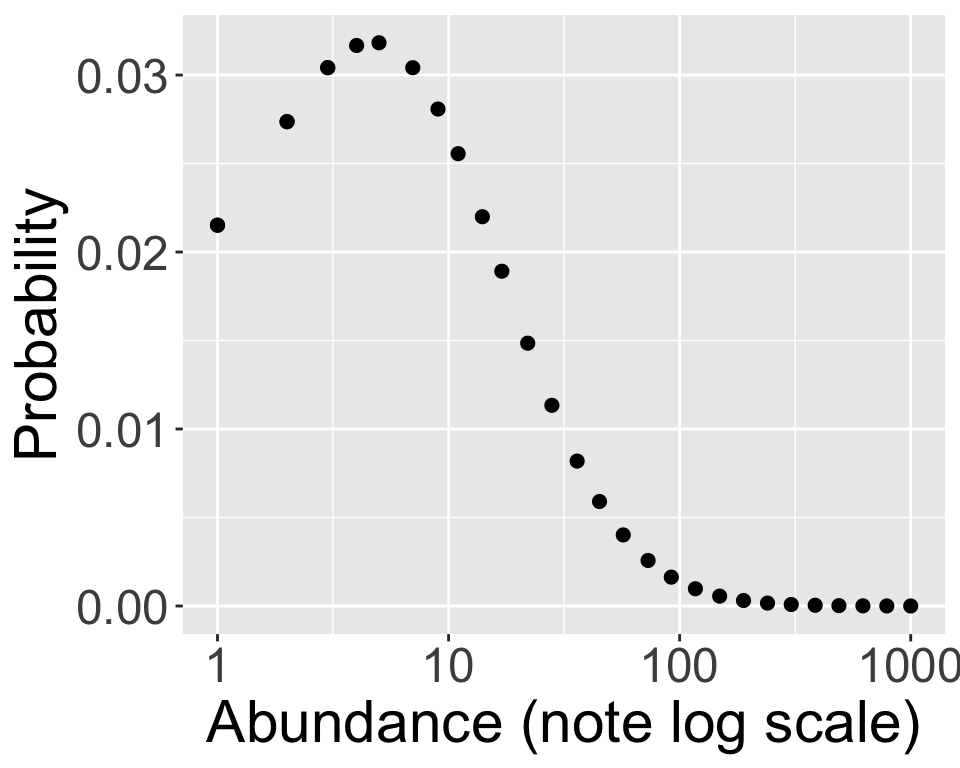
Ecology has spent a long time thinking about the probability distribution of abundances
Turns out the Poisson log normal can accamodate both shapes and a gradient in between
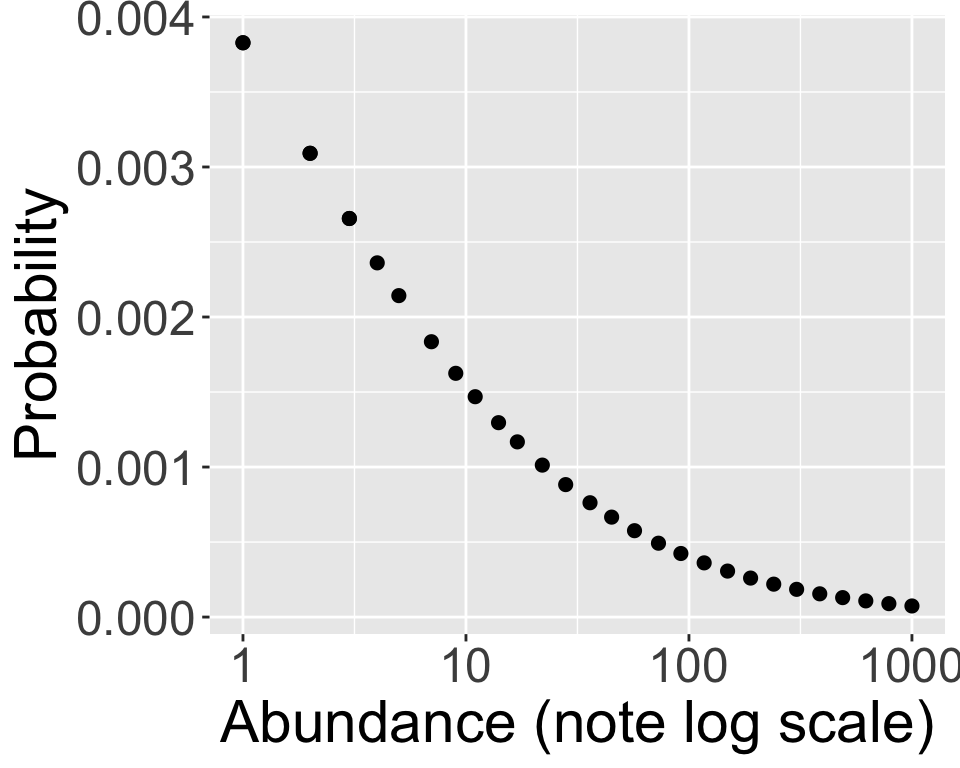
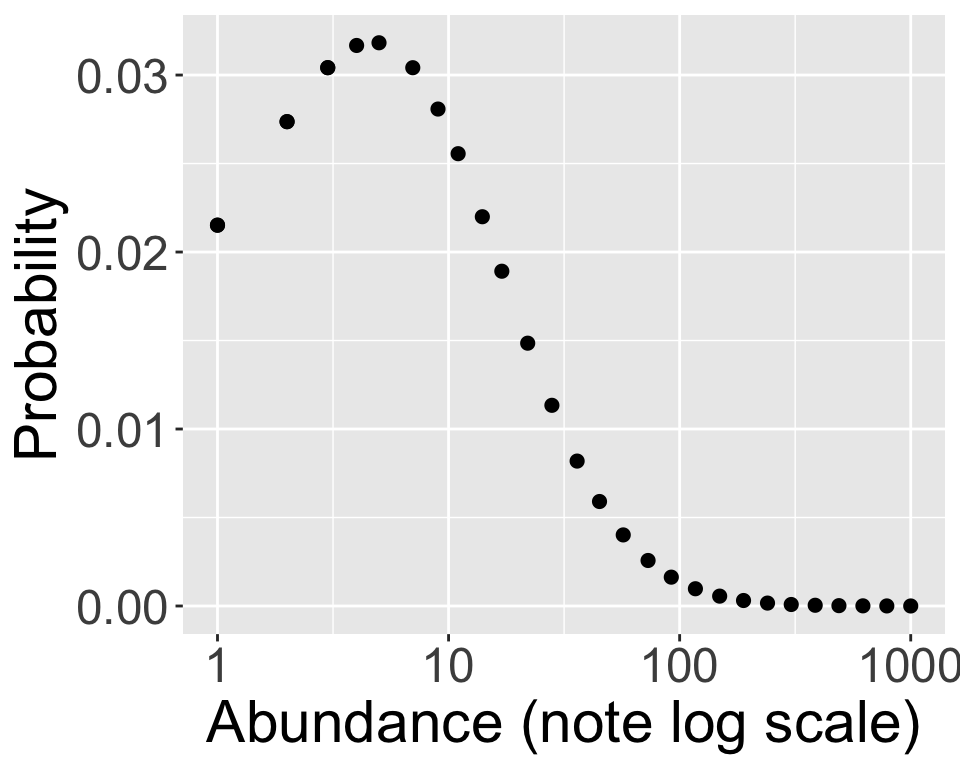
The Poisson log normal
\[ \begin{aligned} \log(\lambda_i) &\sim \mathscr{N}(\mu, ~\sigma) \\ y_i &= \text{Pois}(\lambda_i) \end{aligned} \]
Some familiar looking things
The Poisson log normal as a random effects model
\[ \begin{aligned} \mu_i &= b_0 + b_1 x_{1i} \\ \log(\lambda_i) &\sim \mathscr{N}(\mu_i, ~\sigma) \\ y_i &= \text{Pois}(\lambda_i) \end{aligned} \]
Due to additive property of normal we can rearrange
\[ \begin{aligned} b_{\text{sp} ~i} &\sim \mathscr{N}(0, ~\sigma_\text{sp}) \\ \log(\lambda_i) &= b_0 + b_1 x_1 + b_{\text{sp} ~i} \\ y_i &= \text{Pois}(\lambda_i) \end{aligned} \]
The Poisson log normal as a random effects model
\[ \begin{aligned} b_{\text{sp} ~i} &\sim \mathscr{N}(0, ~\sigma_\text{sp}) \\ \log(\lambda_i) &= b_0 + b_1 x_1 + b_{\text{sp} ~i} \\ y_i &= \text{Pois}(\lambda_i) \end{aligned} \]
This is a random intercepts model, each species gets a random intercept
The Poisson log normal as a random effects model
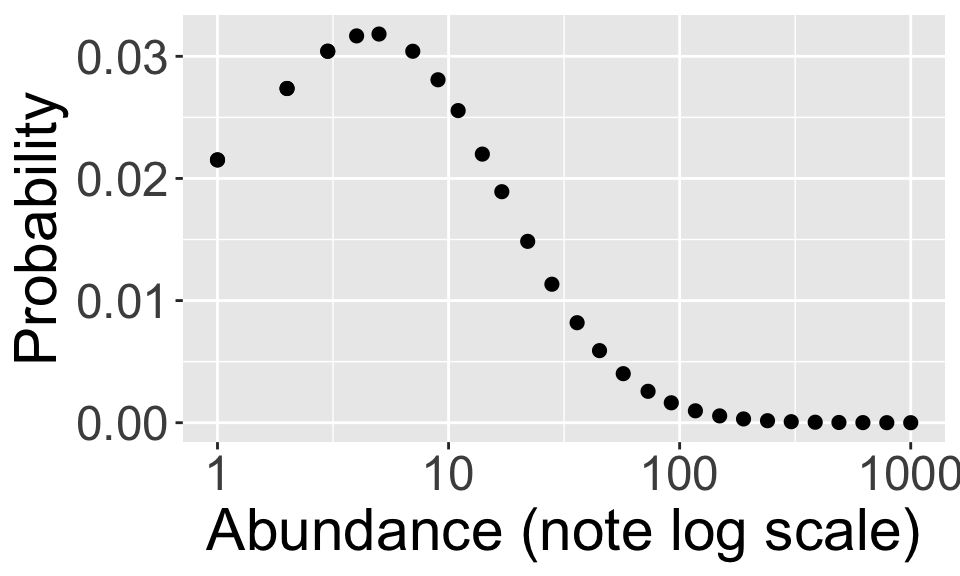
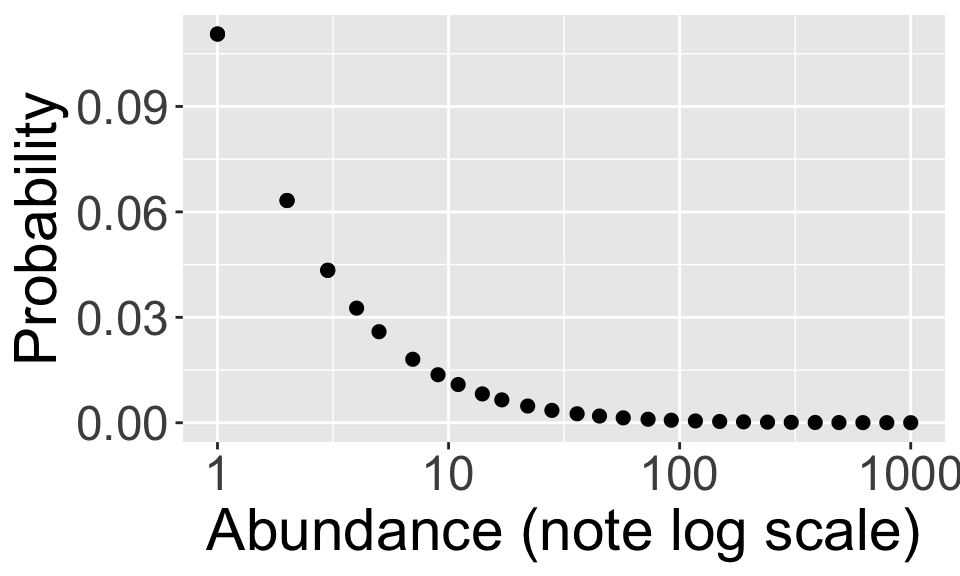
At one sampling location, distribution of abundances will be distributed Poisson log normal
You might be thinking about overdispersion, Poisson log normal is already “overdispersed” and, in fact, quite similar to negative binomial
But what about SAD at another sampling location??
The Poisson log normal as a random effects model
\[ \begin{aligned} b_{\text{sp} ~i} &\sim \mathscr{N}(0, ~\sigma_\text{sp}) \\ b_{\text{site} ~j} &\sim \mathscr{N}(0, ~\sigma_\text{site}) \\ \log(\lambda_{ij}) &= b_0 + b_1 x_1 + b_{\text{sp} ~i} + b_{\text{site} ~j} \\ y_{ij} &= \text{Pois}(\lambda_{ij}) \end{aligned} \]
We need random intercepts for species and site
This model means that a common species will tend to be common everywhere (and a rare species rare everywhere), but there is random variation site-to-site due to demographic noise
The Poisson log normal as a random effects model
Why this is a challenging model
brmHere is the code for just the random effects
brmHow does it look?
Family: poisson
Links: mu = log
Formula: abund ~ (1 | Scientific_name) + (1 | PlotID)
Data: dat_sad (Number of observations: 2150)
Draws: 4 chains, each with iter = 4000; warmup = 1000; thin = 1;
total post-warmup draws = 12000
Multilevel Hyperparameters:
~PlotID (Number of levels: 528)
Estimate Est.Error l-95% CI u-95% CI Rhat Bulk_ESS Tail_ESS
sd(Intercept) 0.92 0.03 0.86 0.98 1.01 994 2692
~Scientific_name (Number of levels: 181)
Estimate Est.Error l-95% CI u-95% CI Rhat Bulk_ESS Tail_ESS
sd(Intercept) 1.17 0.07 1.03 1.32 1.00 1771 3685
Regression Coefficients:
Estimate Est.Error l-95% CI u-95% CI Rhat Bulk_ESS Tail_ESS
Intercept 0.98 0.10 0.78 1.17 1.00 755 1772
Draws were sampled using sampling(NUTS). For each parameter, Bulk_ESS
and Tail_ESS are effective sample size measures, and Rhat is the potential
scale reduction factor on split chains (at convergence, Rhat = 1).
With this approach we can now ask more interesting questions