Introducing CARE and FAIR data principles
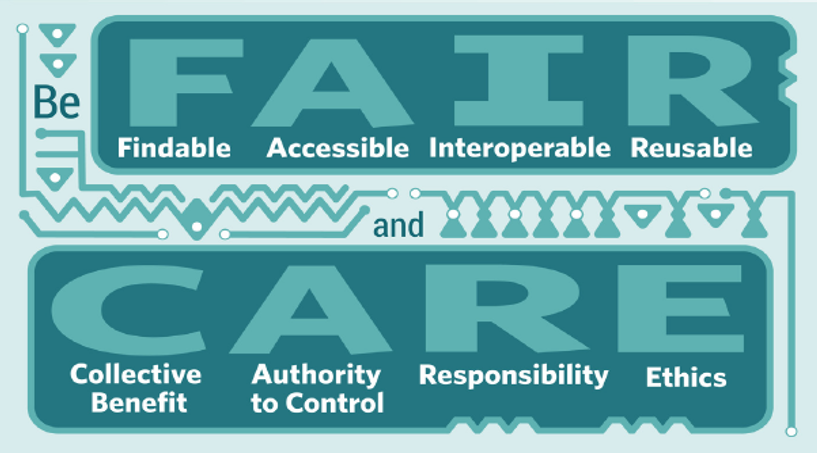
image credit: GIDA (2019)

FAIR

Findable

  • digital object identifier (DOI)
  • searchable (meta)data

GBIF example

FAIR

Accessible

  • only require open source tools to access (meta)data
  • API

GBIF example

FAIR

Interoperable

  • use open community standards
  • (meta)data are licenced for re-use
  • API

GBIF example

FAIR

Reusable

  • (meta)data are licenced for re-use
  • requires robust and clear metadata

GBIF example

  • CC0 Licence: 10.15468/s6ctus
  • Well-organized tabular data (more on that in R refresher)
Scientific name Country or area Coordinates Event date Occurrence status Basis of record Dataset Kingdom Phylum Class Order Family Genus Species
Hyposmocoma (Hyposmocoma) kukilakila Doorenweerd, Austin & Rubinoff United States of America 28.7N, 15.2W 2003 Jun 28 Present Material citation Five New Species of Hawaiian Endemic Fancy Case Caterpillars from a Recently Established Forest Reserve on Maui (Cosmopterigidae: Hyposmocoma) Animalia Arthropoda Insecta Lepidoptera Cosmopterigidae Hyposmocoma Hyposmocoma kukilakila

Let’s look at data for this class

Ethics of FAIR

CARE

What are Indigenous data?

CARE

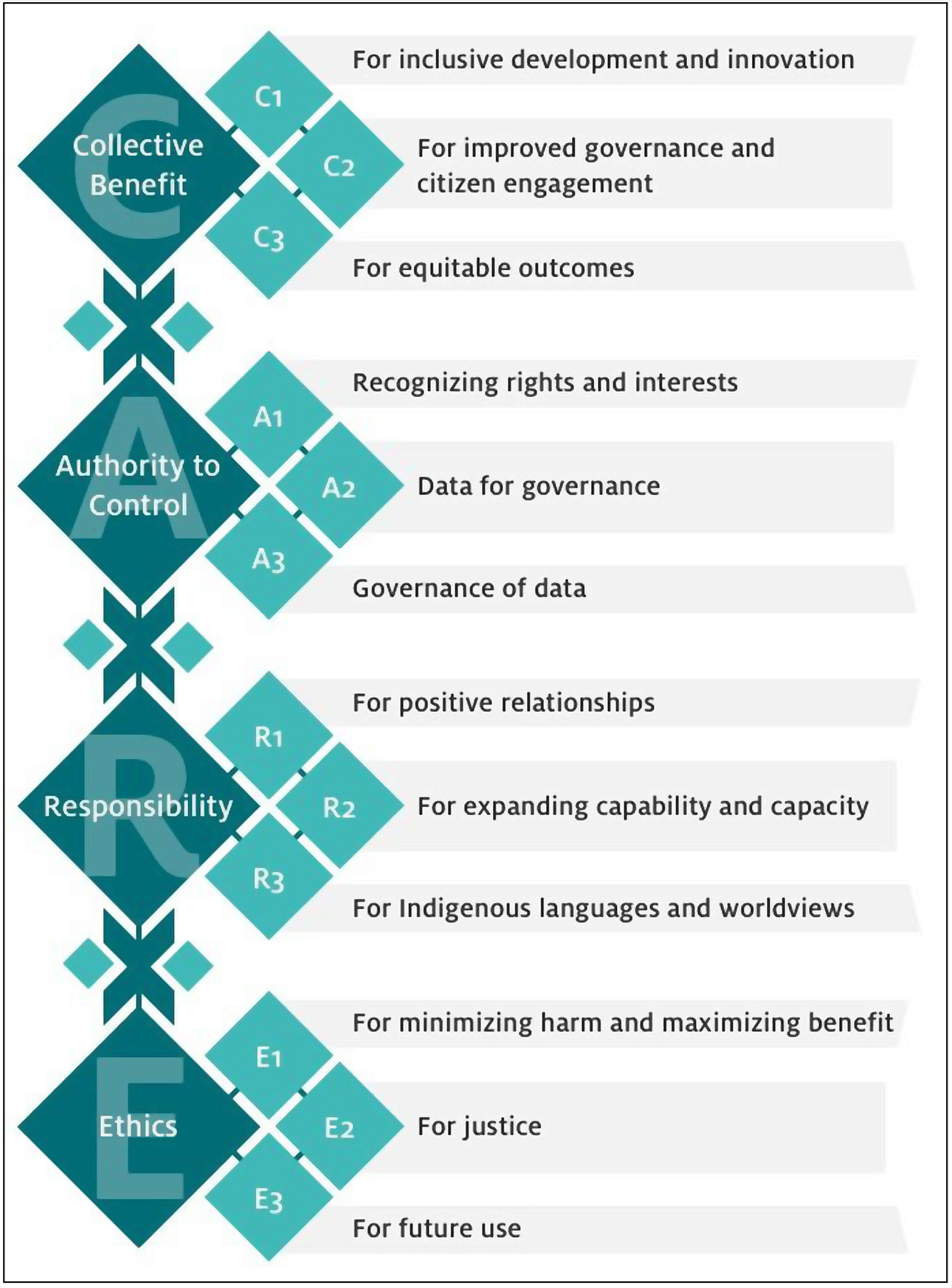
image credit: Carroll et al. (2020)

CARE

Nānā i ke kumu

Prof. Darren Ranco

Who gets to decide

CARE

Nānā i ke kumu

image credit: GIDA (2019)

Māui Hudson

Jane Anderson

Stephanie Carroll

  • FAIR for whom? FAIR for only some is not FAIR at all

CARE

Collective benefit

  • Data hold potential for abundant benefits (not just money)
  • Should benefit community/communities of origin

CARE

Authority to control

  • Indigenous peoples have a right to govern Indigenous data
  • Data are central to governance
  • FAIR can support authority to control

CARE

Responsibility

  • Responsibility to engage with respect, reciprocity, and earned trust
  • Commit to collaborate
  • Seek mutual understanding and regard for multiple worldviews

CARE

Ethics

  • Centering the rights and wellbeing of Indigenous peoples
  • Confront power imbalances
  • Recognize gravity of work

Implementing CARE with Local Contexts

Indigenous metadata are key for CARE
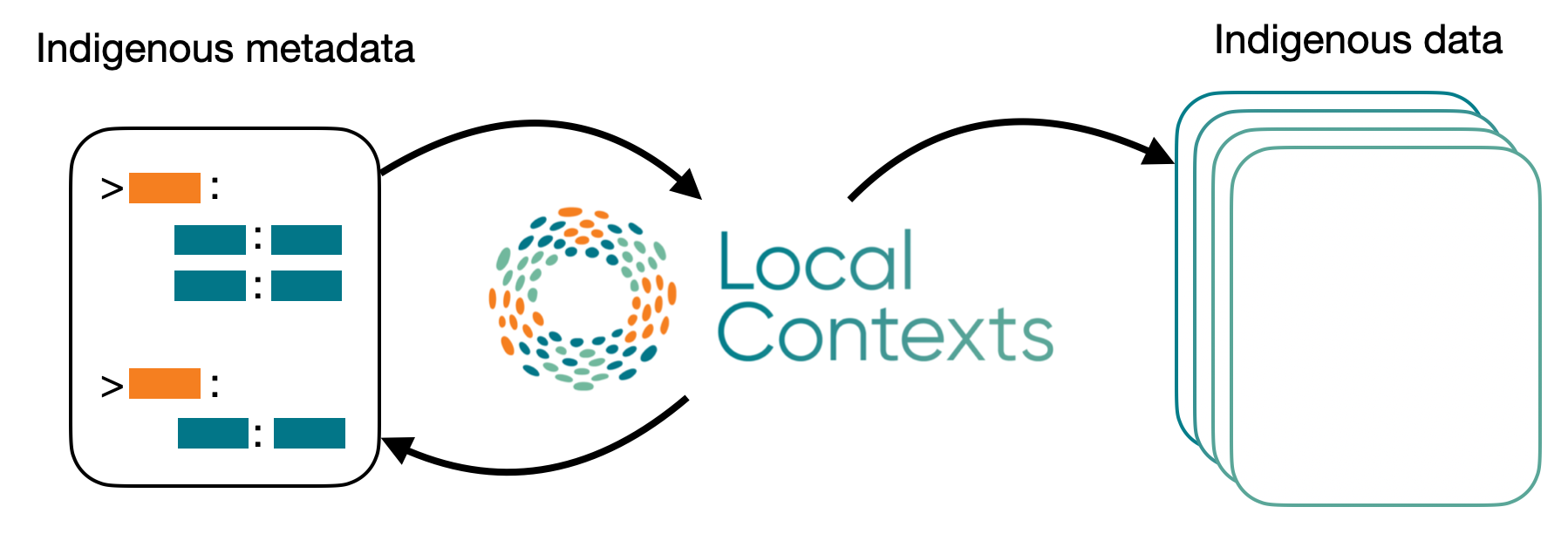
Implementing CARE with Local Contexts

A researcher applies Notices and notifies communities

  • Notices are metadata available to researchers to indicate potential presence of Indigenous rights and interests
  • They allow researchers to fulfill, in part, their Responsibility under CARE

Implementing CARE with Local Contexts

Open to Collaborate

Note: this Notice is being displayed here for educational purposes
  • Engagement notice
  • Indicate a researcher’s or institution’s commitment to CARE principles
  • See full information here

Implementing CARE with Local Contexts

Attribution Incomplete
Note: this Notice is being displayed here for educational purposes and is not attached to data
  • Disclosure notice
  • Indicates that attribution (including provenance and contributors) is incomplete, inaccurate, or missing
  • See full information here.

Implementing CARE with Local Contexts

Traditional Knowledge

Note: this Notice is being displayed here for educational purposes and is not attached to data
  • Disclosure notice
  • Indicates that data representing Traditional Knowledge carry Indigenous rights, protocols, and responsibilities
  • See full information here

Implementing CARE with Local Contexts

Biocultural

Note: this Notice is being displayed here for educational purposes and is not attached to data
  • Disclosure notice
  • Affirms the rights of Indigenous peoples to govern the stewardship of data generated from biological sources within their traditional lands, waters, and territories
  • See full information here

Implementing CARE with Local Contexts

A researcher applies Notices and notifies communities

  • Notices do not articulate the actual rights, interests, protocols of Indigenous peoples
  • Notices are intended to be replaced by Labels

Implementing CARE with Local Contexts

A community applies Labels

  • Labels do articulate the actual rights, interests, protocols of Indigenous peoples
  • Only communities can apply Labels
  • Communities can customize Labels

Implementing CARE with Local Contexts

Provenance Labels

Note: this Label is being displayed here for educational purposes and is not attached to data

TK Attribution (TK A)

Template Text

This Label is being used to correct historical mistakes or exclusions pertaining to this material. This is especially in relation to the names of the people involved in performing or making this work and/or correctly naming the community from which it originally derives. As a user you are being asked to also apply the correct attribution in any future use of this work.

Note: this Label is being displayed here for educational purposes and is not attached to data

BC Provenance (BC P)

Template Text

This Label is being used to affirm an inherent interest Indigenous people have in the scientific collections and data about communities, peoples, and the biodiversity found within traditional lands, waters and territories. [Community name or authorizing party] retains the right to be named and associated with it into the future. This association reflects a significant relationship and responsibility to [the species or biological entity] and associated scientific collections and data.

Implementing CARE with Local Contexts

Permission Labels

Note: this Label is being displayed here for educational purposes and is not attached to data

TK Culturally Sensitive (TK CS)

Template Text

This Label is being used to indicate that this material has cultural and/or historical sensitivities. The Label asks for care to be taken when this material is accessed, used, and circulated, especially when materials are first returned or reunited with communities of origin. In some instances, this Label will indicate that there are specific permissions for use of this material required directly from the community itself.


Note: this Label is being displayed here for educational purposes and is not attached to data

BC Consent Verified (BC CV)

Template Text

This Label is being used to verify that [community name or authorizing party] have consent conditions in place for the use of this information, collections, data, and digital sequence information. [These can be found at ….].

Implementing CARE with Local Contexts

Protocol Labels

Note: this Label is being displayed here for educational purposes and is not attached to data

TK Non-Commercial (TK NC)

Template Text

This material has been designated as being available for non-commercial use. You are allowed to use this material for non-commercial purposes including for research, study, or public presentation and/or online in blogs or non-commercial websites. This Label asks you to think and act with fairness and responsibility towards this material and the original custodians.


Note: this Label is being displayed here for educational purposes and is not attached to data

BC Research Use (BC R)

Template Text

This Label is being used by [community name or authorizing body] to allow this information, collection, data, and digital sequence information (DSI) to be used for unspecified research purposes. This Label does not provide permission for commercialization activities.

[Optional return of research results statement]

Implementing CARE with Local Contexts

What’s next?

  • Getting large supposedly FAIR-compliant data repositories to be CARE

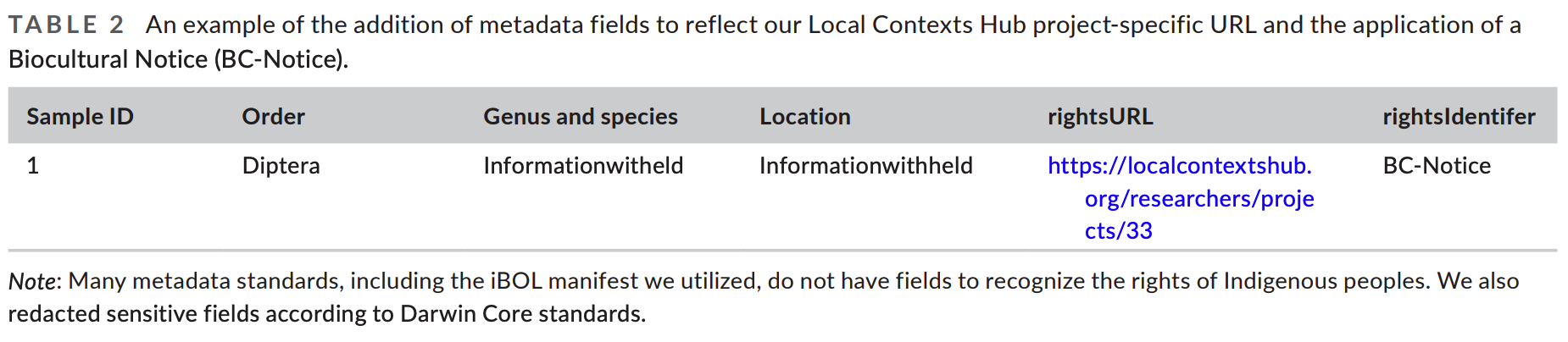
source: Hutchins et al. (2023)

Implementing CARE with Local Contexts

What’s next?

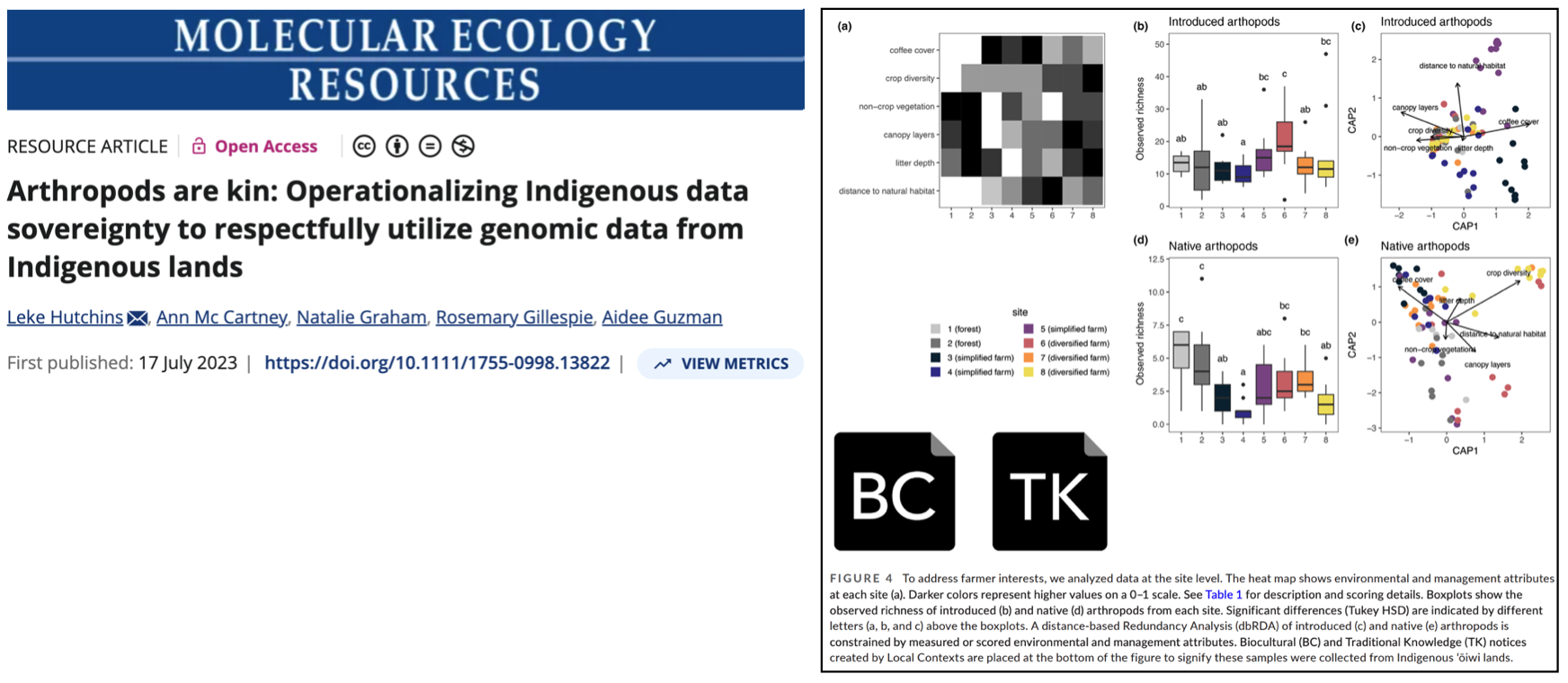
  • Getting journals to integrate CARE metadata
    • Hutchins et al. (2023) did it, but not with full journal support
source: Hutchins et al. (2023)

Implementing CARE with Local Contexts

What’s next?

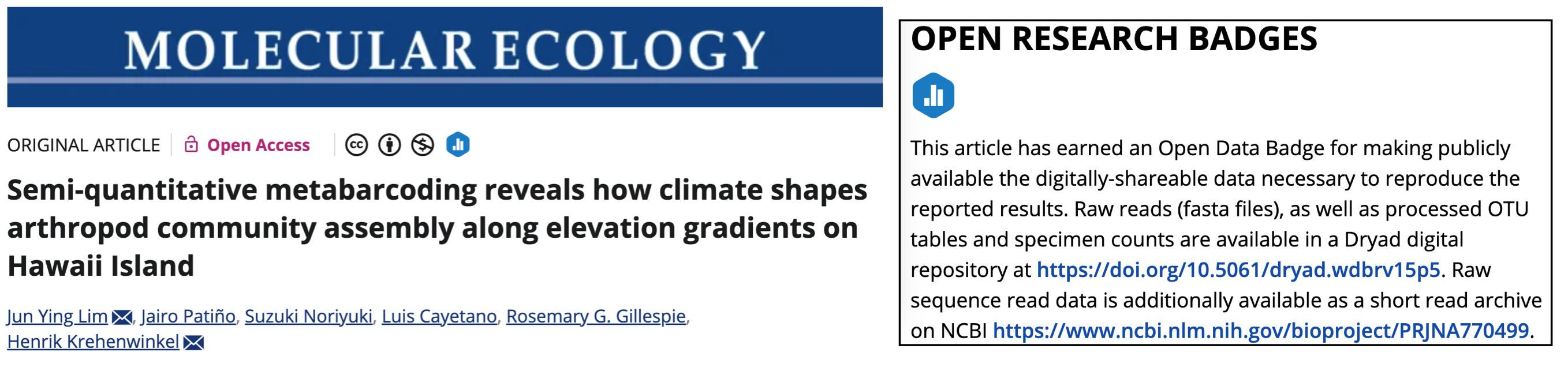
  • Getting journals to integrate CARE metadata
    • Hutchins et al. (2023) did it, but not with full journal support
    • CARE metadata should be right up top with FAIR badges
source: Lim et al. (2021)

CARE and FAIR for this class

Data are pseudo-FAIR compliant but not CARE (so cannot really be FAIR)

CARE and FAIR for this class

Compromises:

  • Place-based teaching and research honors Hawaiʻi
  • But: current data options are non-CARE-complying
  • We can identify ways our individual use can align with CARE
  • But: our individual respect for CARE does not correct the larger problem
  • We can collaborate to envision how these data could meet the CARE principles
  • But: that vision may not be achievable

References

Carroll S et al. 2020. The CARE principles for indigenous data governance. Data science journal 19. Ubiquity Press.
Chen CY, Kahanamoku SS, Tripati A, Alegado RA, Morris VR, Andrade K, Hosbey J. 2022. Systemic racial disparities in funding rates at the national science foundation. Elife 11:e83071. eLife Sciences Publications, Ltd.
Filazzola A, Cahill Jr JF. 2021. Replication in field ecology: Identifying challenges and proposing solutions. Methods in Ecology and Evolution 12:1780–1792. Wiley Online Library.
GIDA. 2019. Research Data Alliance International Indigenous Data Sovereignty Interest Group. CARE Principles for Indigenous Data Governance. https://www.gida-global.org/care.
Hutchins L, Mc Cartney A, Graham N, Gillespie R, Guzman A. 2023. Arthropods are kin: Operationalizing indigenous data sovereignty to respectfully utilize genomic data from indigenous lands. Molecular Ecology Resources 25:e13822. Wiley Online Library.
Larregue J, Nielsen MW. 2024. Knowledge hierarchies and gender disparities in social science funding. Sociology 58:45–65. SAGE Publications Sage UK: London, England.
Lim JY, Patiño J, Noriyuki S, Cayetano L, Gillespie RG, Krehenwinkel H. 2021. Semi-quantitative metabarcoding reveals how climate shapes arthropod community assembly along elevation gradients on hawaii island. Molecular Ecology 31:1416–1429. Wiley Online Library.
Ma A, Mondragón RJ, Latora V. 2015. Anatomy of funded research in science. Proceedings of the National Academy of Sciences 112:14760–14765. National Academy of Sciences.
Maglia A. 2015. NSF data management and public access initiatives.
Nguyen M, Gonzalez L, Chaudhry SI, Ahuja N, Pomahac B, Newman A, Cannon A, Zarebski SA, Dardik A, Boatright D. 2023. Gender disparity in national institutes of health funding among surgeon-scientists from 1995 to 2020. JAMA network open 6:e233630–e233630. American Medical Association.
Nosek BA et al. 2015. Promoting an open research culture. Science 348:1422–1425. American Association for the Advancement of Science.
Parker TH, Forstmeier W, Koricheva J, Fidler F, Hadfield JD, Chee YE, Kelly CD, Gurevitch J, Nakagawa S. 2016. Transparency in ecology and evolution: Real problems, real solutions. Trends in Ecology & Evolution 31:711–719. Elsevier.
Petersen OH. 2021. Inequality of research funding between different countries and regions is a serious problem for global science. Function 2:zqab060. Oxford University Press.
Stebbins M. 2013. Expanding public access to the results of federally funded research.
Wilkinson MD et al. 2016. The FAIR guiding principles for scientific data management and stewardship. Scientific data 3:1–9. Nature Publishing Group.