Introducing probability
Probability in ecology and evolution
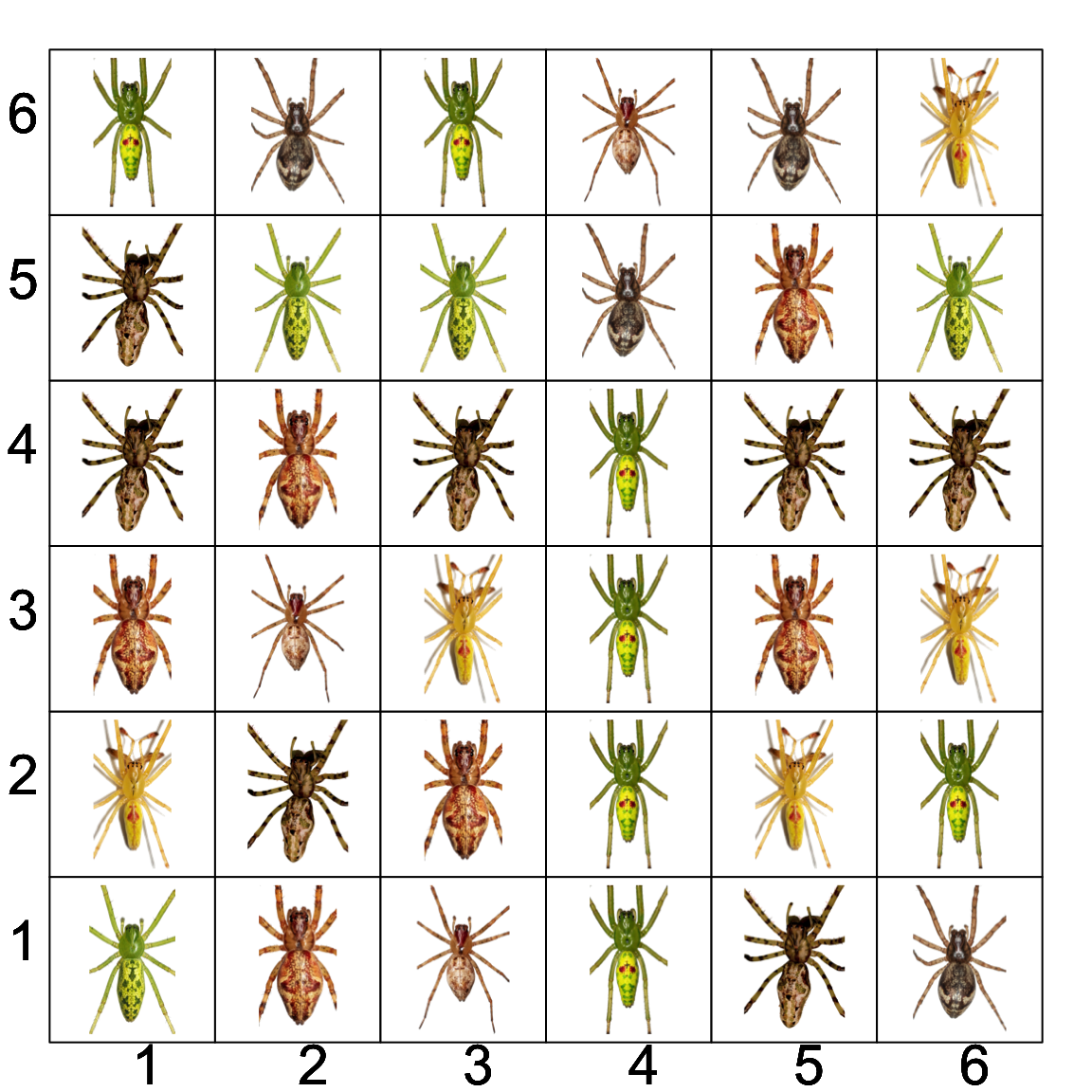
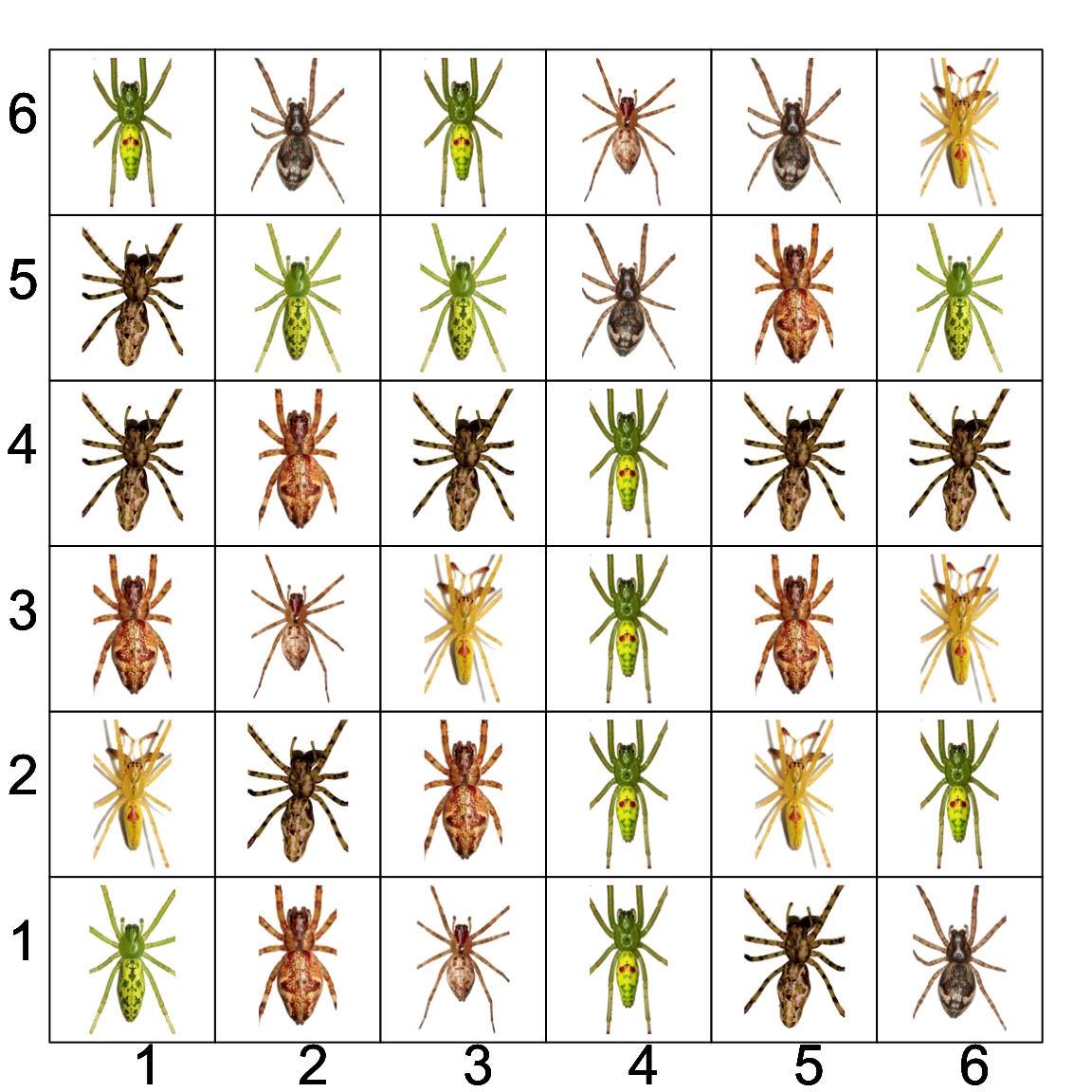
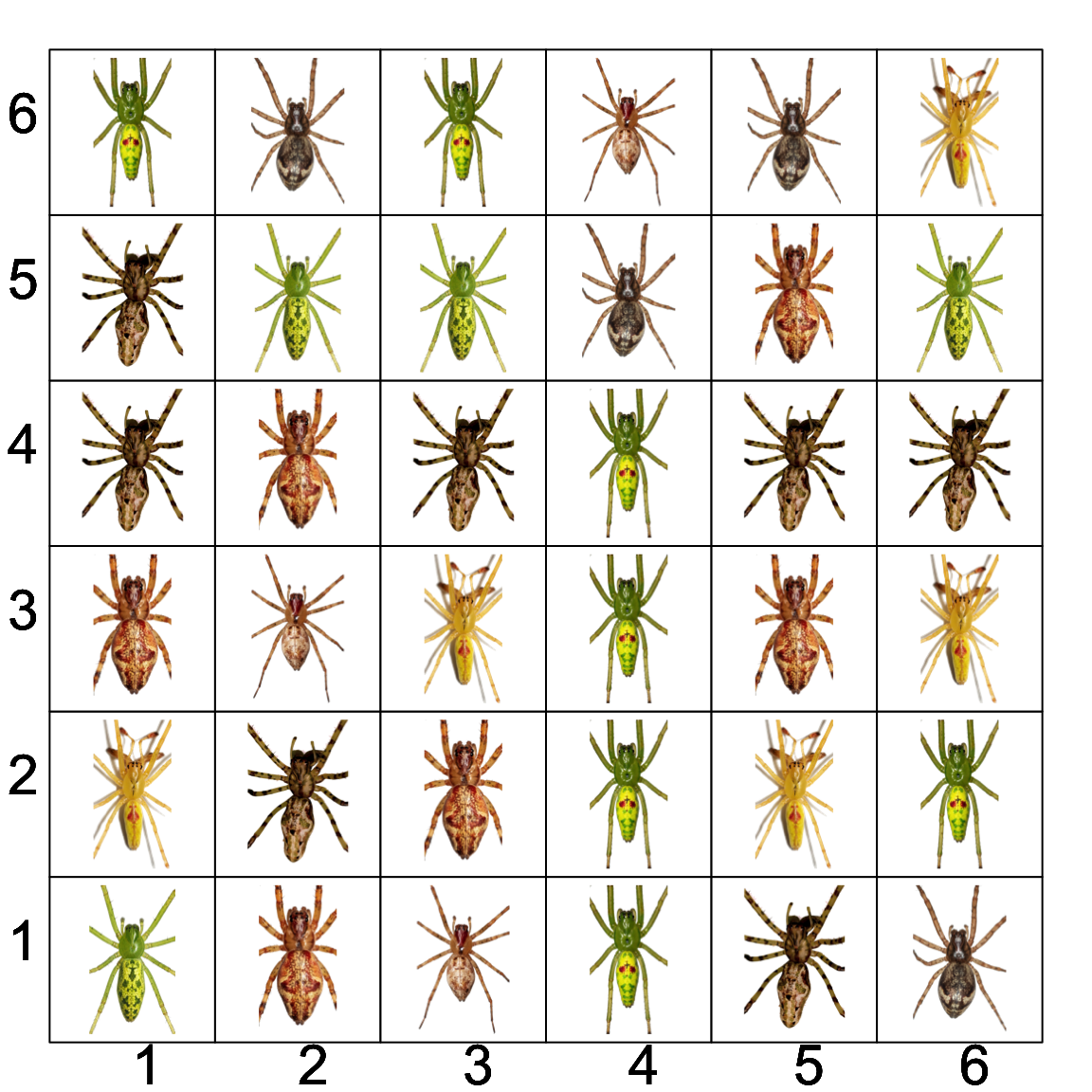
- This “game” is a simplified version of Hubbell’s (2001) Unified Neutral Theory of Biodiversity (UNTB)
- Even the full theory is a simplification of the real world, but can still predict, with surprising accuracy, properties of biodiversity like the species abundance distribution
- UNTB and other models shows us the importance of probability and randomness
Probability in ecology and evolution
How could we play this “game” using just two 6-sided dice?
Let:
- \(m = \frac{1}{3}\)
- \(\nu = \frac{1}{36}\)
Rules of probability
Consider this: probability of speciation \(\nu = 1/12\)
A probability tree can help
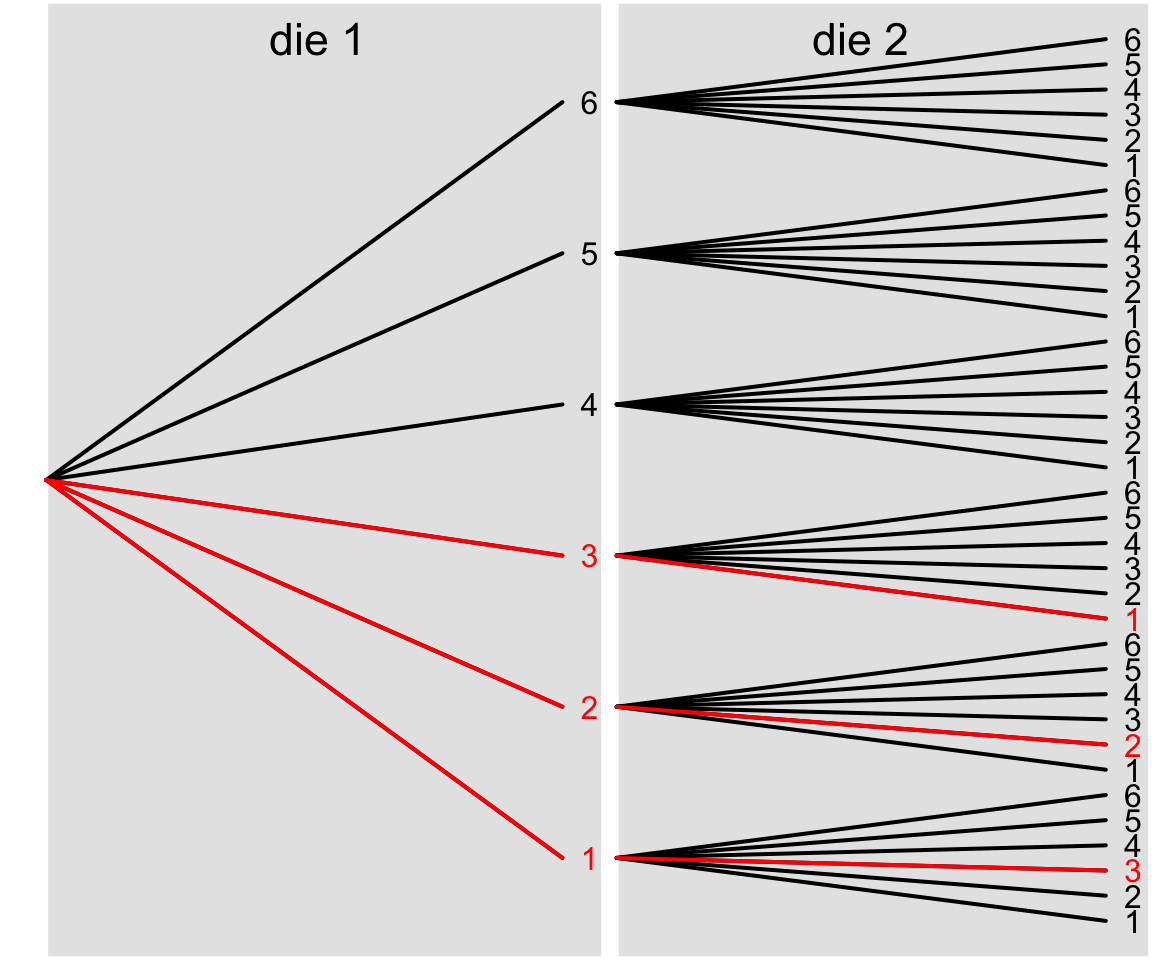
Count up the ways to get sum of two dice = 4, divide by total number of combinations
Rules of probability
Consider this: probability of speciation \(\nu = 1/12\)
Imagine: speciation occurred! What is the probability the first dice was 2 or less?
- Can no longer simply add \(\mathbb{P}(1) + \mathbb{P}(2) = 2/6 = 1/3\)
- Use the probability tree
This is conditional probability: probability of first die \(\leq2\) given sum of two dice is 4
\[ \mathbb{P}(die_1 \leq 2 \mid sum = 4) \]
Rules of probability
Consider this: probability of speciation \(\nu = 1/12\)
Imagine: speciation occurred! What is the probability the first dice was 2 or less?
\[ \mathbb{P}(die_1 \leq 2 \mid sum = 4) = \frac{2}{3} \]
Counting still works, but the condition changes the space over which we count
Rules of probability
Consider this: probability of speciation \(\nu = 1/12\)
We can also use math to help us “count” given a condition
\[ \begin{align} &\mathbb{P}(die_1 \leq 2 \mid sum = 4) \\ &= \frac{\mathbb{P}(die_1 \leq 2~\&~sum = 4)}{\mathbb{P}(sum = 4)} \\ &= \frac{2/36}{3/36} \\ &= \frac{2}{3} \end{align} \]
Probability as couning and as frequency
We have already seen that probability can result from counting
Random variables and probability distributions
Random variables can be described with probability distributions
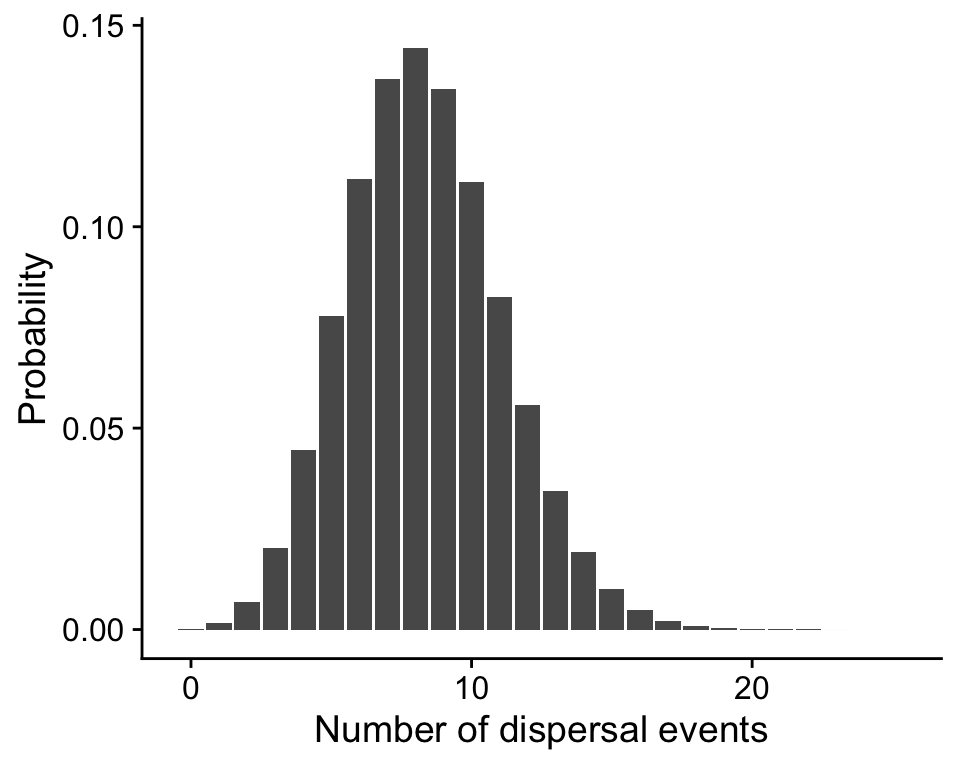
Here is an example for 100 iterations and \(m = \frac{1}{12}\)
Technically the \(r.v.\) could go all the way to 100 on the x-axis, but the probability of that many dispersal events is vanishingly small
Random variables and probability distributions
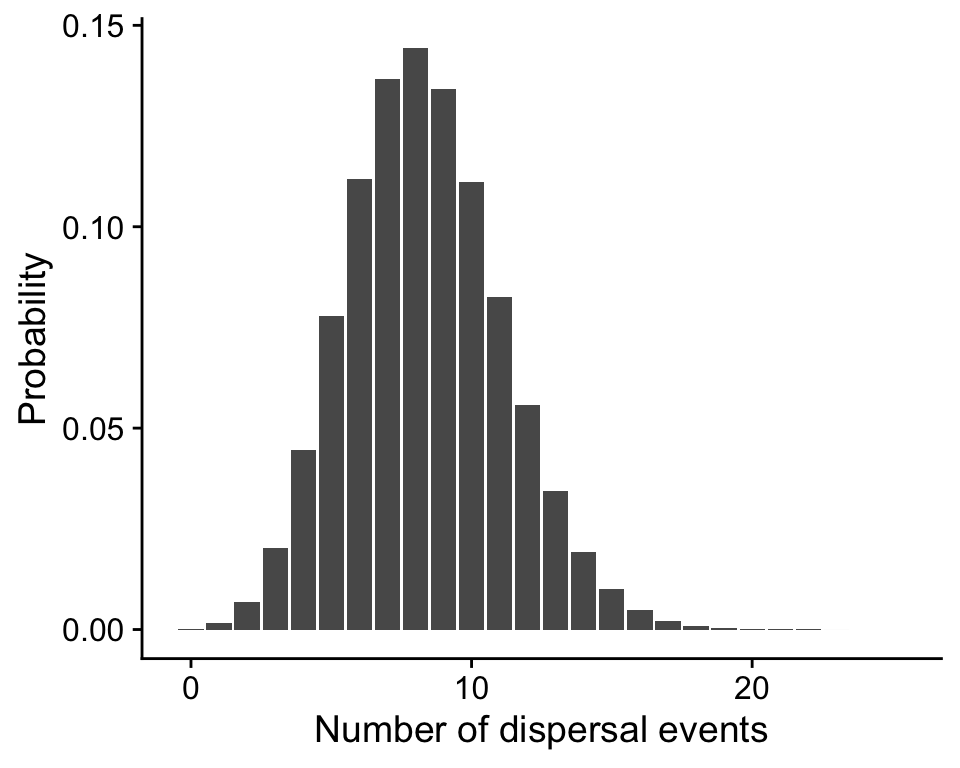
Here is an example for 100 iterations and \(m = 1/12\)
This is a probability mass function because the height of the bars really are probabilities
Random variables and probability distributions
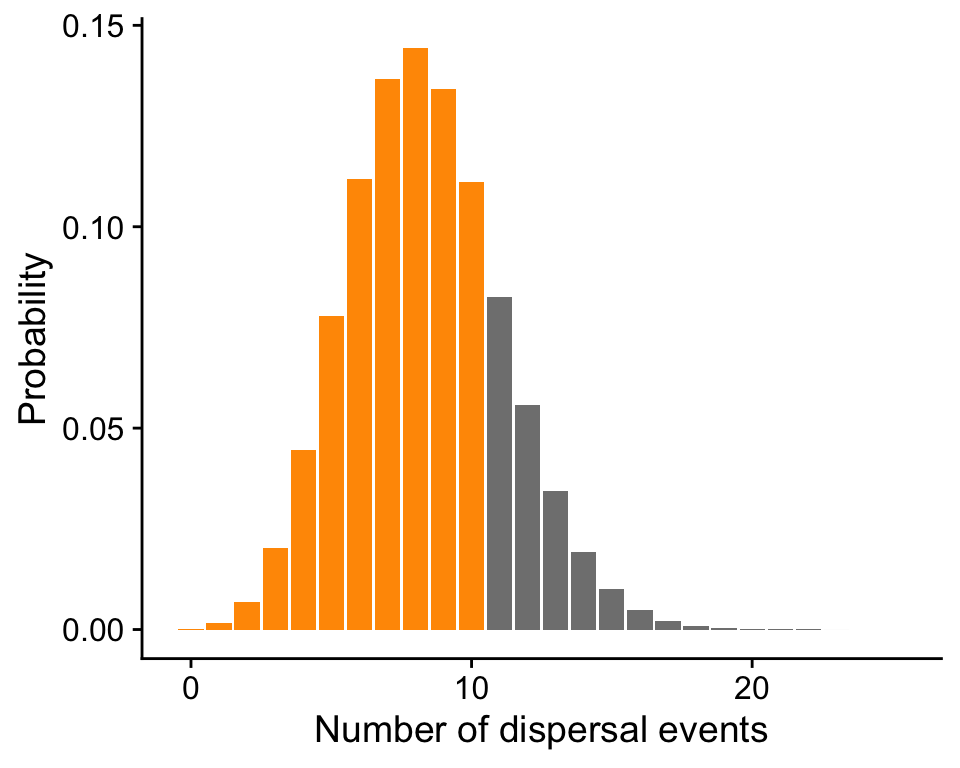
We can add heights of bars to calculate probabilities over ranges of values:
\[ \begin{align} \mathbb{P}(n \leq 10) &= \sum_{i = 0}^{10} \mathbb{P}(n = i) \\ &= 0.79 \end{align} \]
Random variables and probability distributions
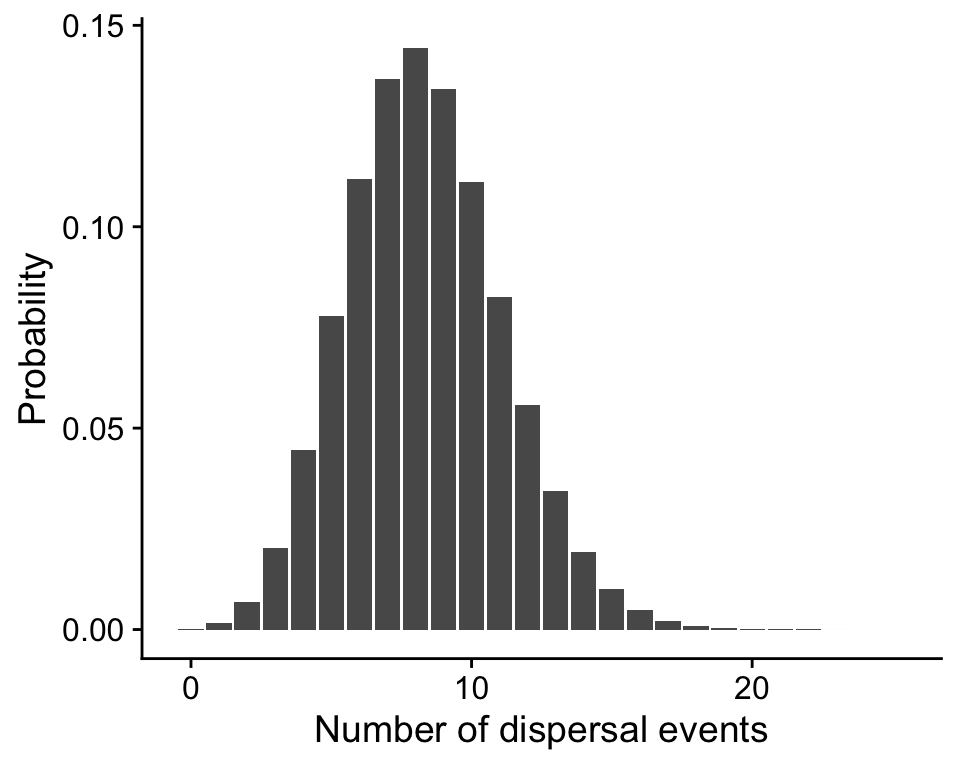
We emphasized this is a probability mass function (PMF) because heights of bars are actual probabilities
This applies when the r.v. is discrete (e.g. an integer)
Random variables and probability distributions
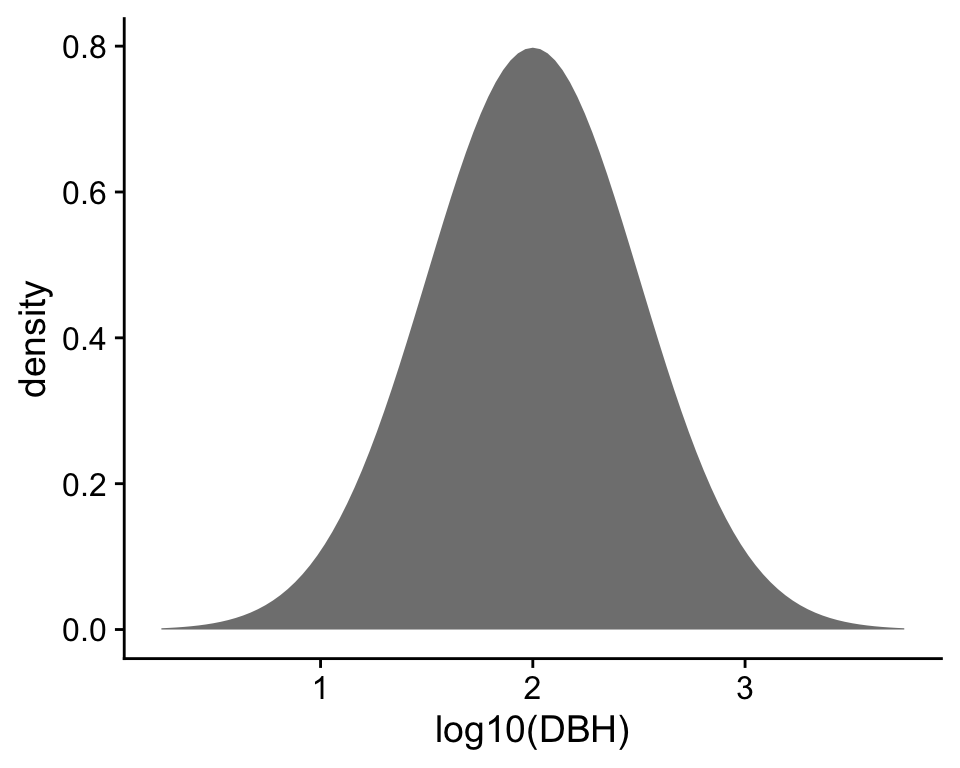
For a continuous r.v. like diameter at breast height, the y-axis is not equal to probability because \(\mathbb{P} \rightarrow 0\) for a continuous value with infinite precision
Instead we think of probability density and thus a probability density function (PDF)
Random variables and probability distributions
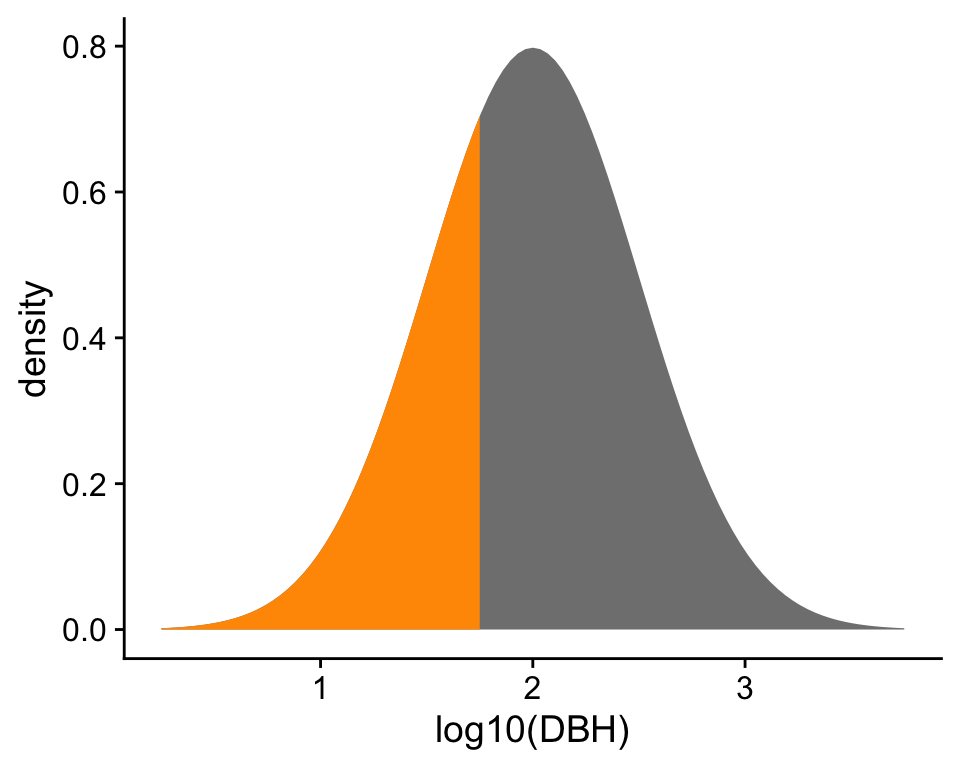
If we “add up” (technically integrate) the area under the PDF curve we again arrive at a real probability
e.g., according to this PDF \(\mathbb{P}(\log_{10}(DBH) \leq 1.75) = 0.309\)
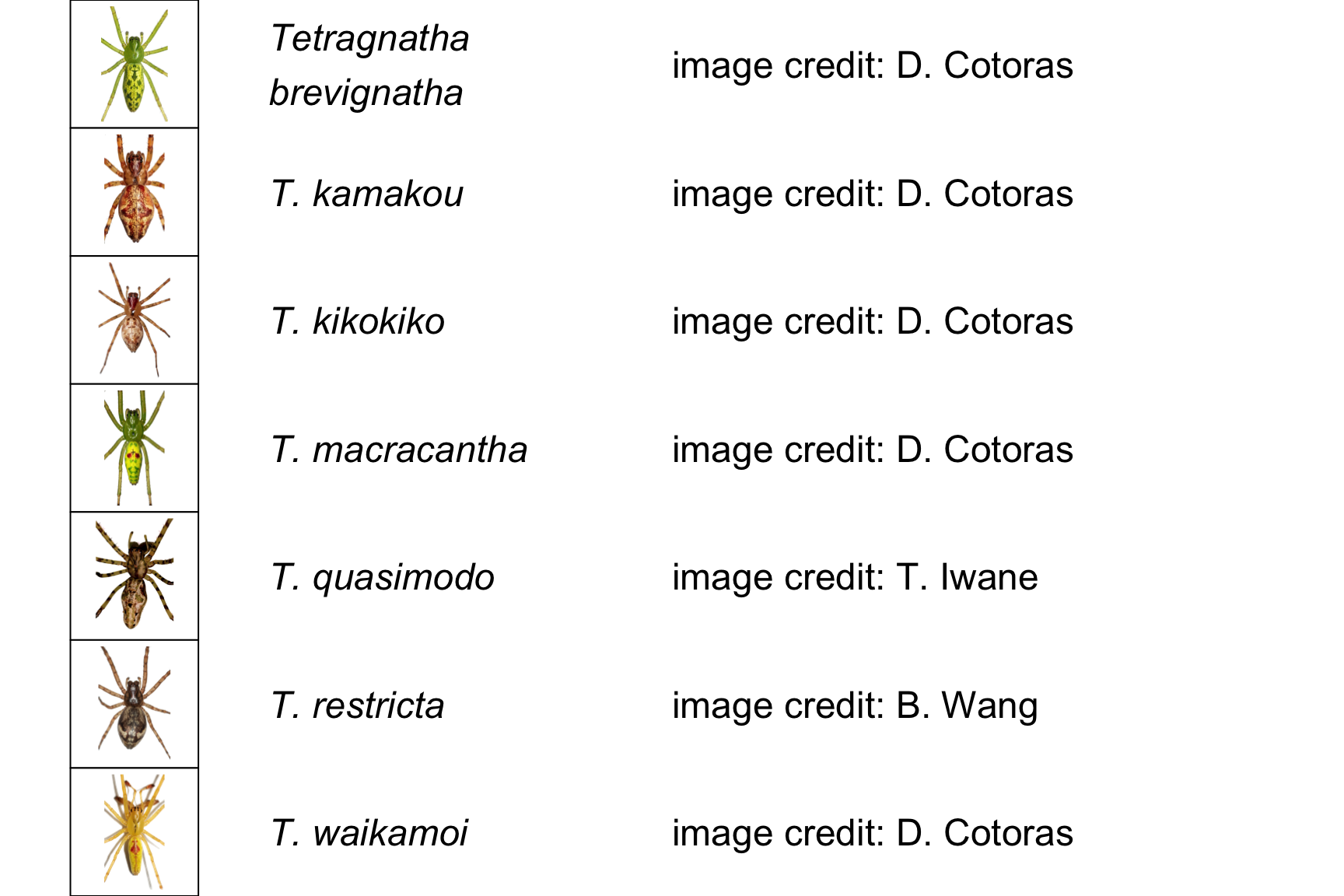
Spider image credits