2 CARE and FAIR principles
Jump to slides.
CARE and FAIR are principles that specify different but complimentary ethical considerations for the collection, management, use, and governance of data (Carroll et al. 2021). The concepts underlying CARE articulate ideas of Indigenous data sovereignty and governance that have deep historical roots (UN General Assembly 2007; Kukutai & Taylor 2016; Carroll et al. 2020; Carroll et al. 2021). The concepts in FAIR relate to the more recent idea of open and reproducible science. We will discuss FAIR first, though it is not the chronologically earlier concept nor more important, because the current articulation of CARE contends with the fact that FAIR is the emerging default for data (Carroll et al. 2021).
2.1 FAIR
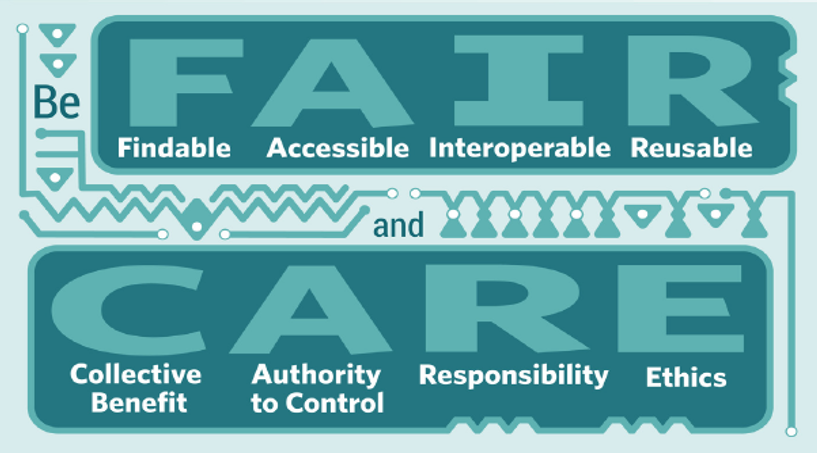
FAIR (Wilkinson et al. 2016) stands for Findable, Accessible, Interpretable, and Reusable. We’ll go through what each of those mean in practice and then briefly discuss the underlying ethics.
2.1.1 Findable
This means data and metadata should be easy to find by both humans and computers. Data should have persistent identifiers such as a digital object identifier (DOI) and have sufficient structured information such that it is searchable. As an example, the Global Biodiversity Information Facility (GBIF) houses species occurrence data (think museum and herbarium specimens) and assigns DOIs to every submitted data set and every user download. That downloads have a DOI means that research using those downloaded data can reference the DOI, making the exact data underpinning the research finable. GBIF also enables searching for data by different criteria including taxonomy and geographic location.
2.1.2 Accessible
This means that once found, data and metadata should be retrievable by both humans and computers. Importantly, accessible in this context means metadata are always accessible, even if raw data cannot be accessed (e.g. for ethical reasons). The method for downloading or requesting access to (meta)data should be clear and not require specialized or proprietary tools but rather standardized, open (as in open source) protocols. For example. GBIF allows humans to select data for download through a web interface and complete the download through standard HTTP protocols. GBIF also serves an application programming interface (API) which allows data to be downloaded through automated computer workflows. Other examples of repositories with accessible data are Dryad Digital Repository and Zenodo, two resources we retrieved data from for this class.
2.1.3 Interoperable
Data and metadata should use broadly applicable, formal data standards that are themselves FAIR. It should use standardized formats that allow data to be integrated with other data sets and used with various applications. As an example, GBIF uses the Darwin Core standard which provides a shared vocabulary for occurrence-based biodiversity (meta)data, with terms like scientificName, decimalLatitude, and eventDate. These terms can be thought of as standard column names that all data should have in order to meet the Darwin Core standard. All other data that use Darwin Core, or another standard that can be transliterated to Darwin Core, can now interoperate.
2.1.4 Reusable
To be refundable data must be well-described with accurate metadata, including provenance, and have clear licensing that allows for reuse. In this context provenance is taken to mean the researchers who generated the data and how they generated it. In our discussion of CARE, provenance will take on a much deeper and more accurate meaning. The Darwin Core standard enables metadata to meet the reusability standard as long as the specific licence allows reuse. GBIF, for example, requires data to be licensed under a Creative Commons license. Another metadata standard worth noting is the Ecological Metadata Language which provides additional ways of describing data that do not neatly fit within the occurrence-type data most easily described by Darwin Core.
2.1.5 Ethics of FAIR
Global and local disparities in science funding access (Ma et al. 2015; Petersen 2021; Chen et al. 2022; Nguyen et al. 2023; Larregue & Nielsen 2024) means that a small proportion of researchers have dominated the means of producing data. If data were not FAIR, researchers without access to the same funding would be further disadvantaged and their contributions to science would be further lost. FAIR also came to the scientific forefront in response to the replication crisis (Nosek et al. 2015; Wilkinson et al. 2016). It is hoped that making data open and reusable will make science more transparent and reproducible (Parker et al. 2016; Filazzola & Cahill Jr 2021). Greater transiency and reproducibility should make science less prone to the analytical errors and biases that led to the replication crisis, as well as make the scientific record quicker and easier to correct when errors do occur. Most scientific data is also publicly funded and therefore there are ethical considerations for making data broadly accessible by everyone, public included, and reusable to ensure the highest scientific return on the investment from the public (Stebbins 2013; Maglia 2015).
2.2 CARE
While ethics are implied in FAIR, CARE intentionally addresses them head-on in the context of Indigenous peoples’ rights (UN General Assembly 2007; Carroll et al. 2020; Carroll et al. 2021). CARE is an articulation of Indigenous data sovereignty (IDSov) and Indigenous data governance (IDGov). IDSov and IDGov apply to Indigenous data. Indigenous data are any form of data (including traditional knowledge, language, physical materials, digital records, and more) in any format that originate from or impact Indigenous peoples, people, communities, nations, territories (including traditional territories now occupied by colonizers), and all their constituent pieces from natural “resources” to human bodies to cultural expression (Carroll et al. 2021).
Where data “originate from” is a way of saying what is the provenance of the data. We saw provenance when discussing the necessity of clearly describing data under FAIR. From a colonial perspective the provenance of data sits with the researcher extracting data. But a de-colonial perspective reveals that the provenance sits with the original knowledge holders and/or stewards of the sources (e.g. lands and waters) of knowledge. The provenance of an academic recording of ʻōlelo Hawaiʻi spoken by a mānaleo does not sit with the academic but with the speaker and more broadly with Kānaka ʻŌiwi. The provenance of an entomological collection from the Waiʻanae Mountains on Oʻahu does not sit with the collector (whose name is likely attached to each specimen) but with the ʻāina, the lāhui Hawaiʻi, and Kānaka ʻŌiwi. The distinction about provenance is important because, under western intellectual property systems, provenance and ownership are assumed to be equivalent. Who “owns” the data governs the data. IDSov and IDGov work to recenter Indigenous worldviews, rights, self-determination, and wellbeing in data stewardship, rather than western notions of property.
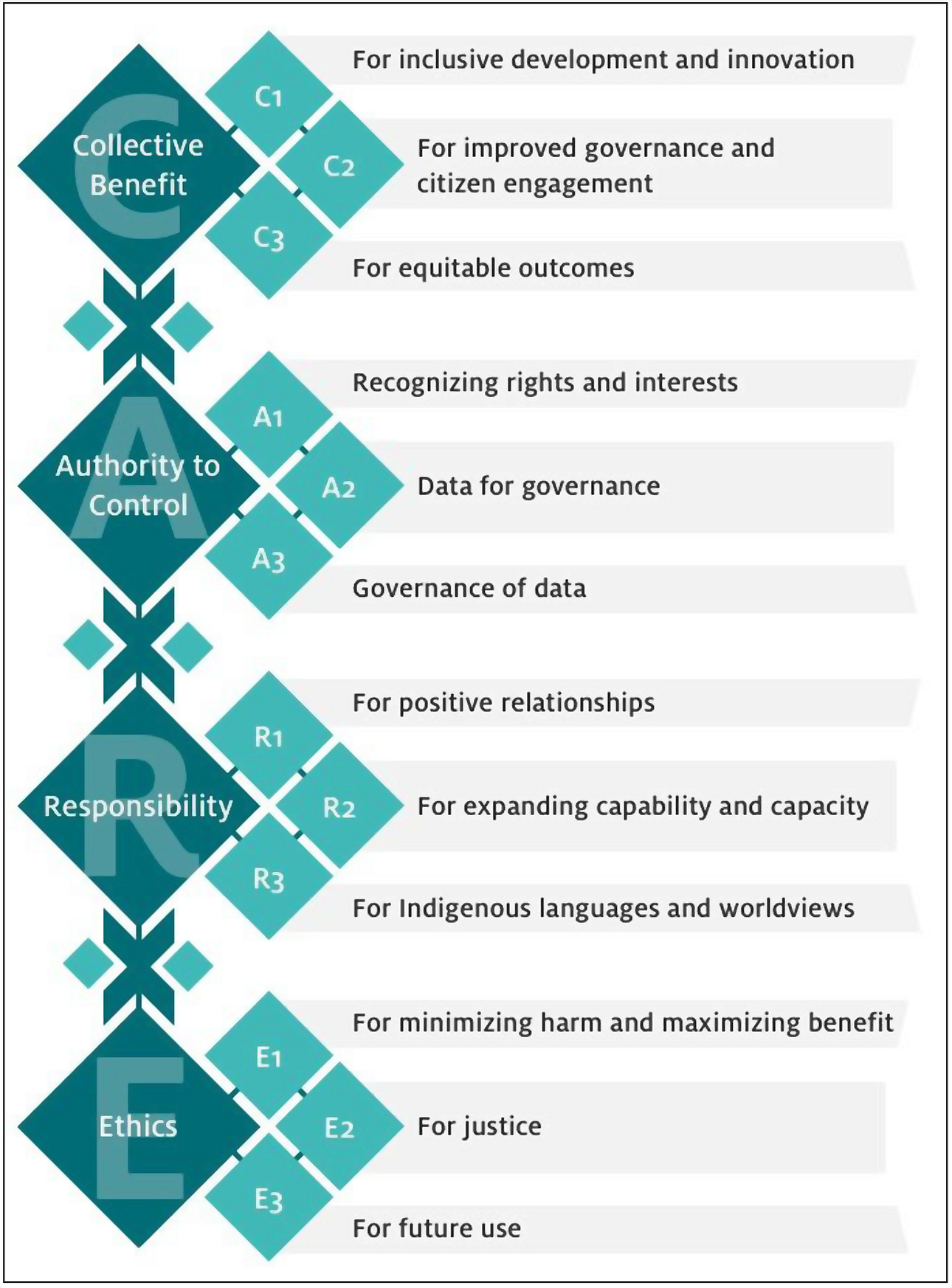
We will start to build understanding of IDSov and IDGov by defining CARE. CARE (GIDA 2019; Carroll et al. 2020) stands for Collective benefit, Authority to control, Responsibility, and Ethics. We will dive deeper into each.
2.2.1 Collective benefit
Data inherently hold potential for innovation, value generation, and decision making. People, communities, and nations can benefit from data. The collective benefit principle stipulates that benefits should be shared collectively and specifically that data stewardship practices must enable Indigenous peoples and people to derive benefit from Indigenous data. Benefit is sometimes—in western worldviews—reflexively equated with monetary value, but benefit takes many forms including the benefit of using data to inform governance and decision making, and generally to promote wellbeing.
2.2.3 Responsibility
Those working with Indigenous data have a responsibility to engage with respect, reciprocity, and earned trust. Respect must be given to cultural protocols and rights to self-determination. Reciprocity is about ensuring that not only the benefits derived from data can advance Indigenous peoples’ wellbeing, but the process of data collection and stewardship have embedded practices of collaboration that expand the capacity (e.g. through increased data literacy) of Indigenous peoples and people to engage with data. Reciprocity and respect are also about seeking mutual understanding of worldviews and ensuring that data and their products are communicated in a way consistent with those worldviews, including in the Indigenous language of the people of provenance. Earned trust means those working with Indigenous data embrace the responsibility of collaborating with integrity and consistently support positive relationships.
2.2.4 Ethics
Ethics means centering the rights, wellbeing, and ethical frameworks of Indigenous Peoples in the stewardship of Indigenous data. To do so requires grappling with the ways colonialism and colonists create power imbalances, scarcities (real and constructed), and trauma. This work is not trivial, which also means ethics include honoring that work by ensuring the longevity of data and its potential to produce benefits into the future. Indicating Indigenous provenance is part of ensuring future ethical use.
2.3 CARE and FAIR together
Stephanie Carroll and colleagues (2021), leaders in IDSov and IDGov, point out that FAIR principles can support operationalizing CARE and vice versa. Indigenous data are all too often rendered hidden, inaccessible, not reusable, and not interoperable by colonial power imbalances and institutions (Carroll et al. 2021). Making such data FAIR is necessary in these cases to begin the process of implementing CARE. From personal experience (Andy speaking here) CARE can be perceived by some researchers in colonizer institutions to curtail the implementation of FAIR, but this is misguided. As pointed out in the articulation of CARE (GIDA 2019), Indigenous data cannot be used in good conscience without “relationships built on respect, reciprocity, trust, and mutual understanding, as defined by the Indigenous Peoples to whom those data relate” (quoting from GIDA (2019)). Thus without CARE, the R (reusable) in FAIR is invalid. Operationalizing CARE results in richer, more complete metadata, and complete metadata underpin all aspects of FAIR.
Perceived conflicts between FAIR and CARE might be resolved by asking “FAIR for whom?” and “who gets to decide?” Who gets to decide which protocols are implemented to access and reuse data? Who can find and access the data (i.e. findable and accessible for whom)? Who decided what metadata to expose to make data findable by which search terms? With whose worldview do those search terms align? Contemplating these questions might result in the conclusion that individuals or institutions that are asked to share power—power that previously was not shared—may perceive this CAREful sharing as limiting FAIR. But CARE does not limit FAIR. Rather, colonial power imbalances make data “FAIR” for some but not all, which is not actually FAIR.
2.4 Implementing CARE with Local Contexts Labels and Notices
Operationalizing CARE produces metadata. Having metadata standards is one important aspect of FAIR. The IDSov and IDGov focused organization Local Contexts offers one emerging implementation of standard CARE metadata via their Labels and Notices (Local Contexts 2025a, 2025b). Labels are used by Indigenous communities and nations to articulate their rights to and interests in Indigenous data. Notices are used by researchers and colonizer institutions to affirm the existence of Indigenous rights and interests and acknowledge that work is underway to articulate those rights and interests. Notices also indicate the readiness of researchers and colonizer institutions to fulfill their responsibilities (the R in CARE) of centering Indigenous worldviews, self-determination, wellbeing, and rights in data stewardship.
For metadata to be useful they need to be FAIR. To make Local Contexts Labels and Notices FAIR they are hosted on the Local Contexts Hub, an online repository. To work with these metadata, communities, researchers, and colonizer institutions must first make an account on the Hub (free for communities and researchers, paid on a subscription basis for institutions). Local Contexts Hub is structured by projects. Labels and Notices are applied to data by connecting both to a project. Projects have permanent unique identifiers and persistent URLs based on those identifiers, replicating the permanence of DOIs.
To understand this better we will walk through the a Local Contexts workflow from the perspective of a researcher initiated the process, because “researcher” is likely the common aspect of identity shared by those participating in this course.
2.4.1 A researcher applies Notices and notifies communities
The Local Contexts Hub workflow for a researcher should ideally begin with co-production of research goals and data management with local communities in real life outside of the Hub. For archival data already collected (the majority of data) this likely did not occur. Within the Hub a researcher creates a project to correspond to Indigenous data they are working with. The Hub does not house the data itself, only the metadata. Then Notices are applied to the project and communities are notified via the Hub. Again, ideally, researchers and communities will already be working together because even the act of defining what data are and the geographic or other bounds that delineate one data set (and thus one Hub project) from another can be surprisingly different across different ways of knowing. But projects can still be created and Notices applied in situations where co-production has not occurred (don’t let perfect be the enemy of good).
Notices, again, affirm the existence of Indigenous rights to and interests in specific data. A notice is three things: 1) a visual badge drawing the focus of a person engaging with Indigenous data; 2) human-readable text explaining the significance of the Notice; and 3) a machine-readable string that can be integrated into data processing and management workflows. There are multiple Notices each with unique purpose. We will focus on four that individual researchers are most likely to use.
2.4.1.1 Open to Collaborate

The Open to Collaborate Notice is an Engagement Notice that can be used to indicate a researcher’s or institution’s commitment to CARE principles and working collaboratively on issues of IDSov and IDGov. Engagement Notices are not applied to data, but rather are appropriate to display on, for example, research or institution websites. You might recall we use this notice on the landing page of this course website. See full information here.
2.4.1.2 Attribution Incomplete

The Attribution Incomplete Notice is applied to data to indicate that attribution (including provenance and contributors) is incomplete, inaccurate, or missing. This notice indicates a work in progress toward correcting the mistake of incomplete attribution. See full information here.
2.4.1.3 Traditional Knowledge

The TK Notice indicates that data representing Traditional Knowledge and related terms/concepts (Traditional Ecological Knowledge, Indigenous Knowledge, Indigenous Science) carry Indigenous rights, protocols, and responsibilities. See full information here.
2.4.1.4 Biocultural

The BC Notice affirms the rights of Indigenous peoples to govern the stewardship of data generated from biological sources within their traditional lands, waters, and territories. See full information here.
Notices, because they represent a commitment to Responsibility and CARE, are expressly not to be modified by researchers/colonizer institutions according to the Notices usage guide. Notices are also not meant to be the permanent metadata associated with Indigenous data because the Notices do not themselves articulate the rights and protocols of Indigenous peoples. That is the job for Labels.
2.4.2 A community applies Labels
To re-iterate, this workflow is from a researcher’s perspective. Indigenous communities can also create projects connected to data without need for researchers external to their communities creating the project and applying Notices. We are using the researcher-initiated example here because we are all researchers, but not all of us may be Indigenous or authorized to speak for Indigenous communities.
In the researcher-initiated workflow, once Notices are applied to data via a project, an Indigenous community can then replace Notices with Labels. Unlike Notices, Labels do articulate the rights, interests, and protocols of Indigenous peoples. There are many different Labels, indeed there needs to be many to express rights, interests, and protocols. Only communities can apply Labels, they are out of the purview of researchers and colonizer institutions. It should of course be noted that researchers can belong to the community of origin for the data they work with. Such scholars may have roles in both applying Notices and applying Labels if they are given that authority by their community.
The Labels are organized into Traditional Knowledge (TK) and Bicultural (BC) categories, and within each category there are Provenance, Protocol, and Permission Labels. Below are example Labels from each grouping (template text is quoted directly from the hyperlinked sources).
2.4.2.1 Provenance Labels

Template Text
This Label is being used to correct historical mistakes or exclusions pertaining to this material. This is especially in relation to the names of the people involved in performing or making this work and/or correctly naming the community from which it originally derives. As a user you are being asked to also apply the correct attribution in any future use of this work.

Template Text
This Label is being used to affirm an inherent interest Indigenous people have in the scientific collections and data about communities, peoples, and the biodiversity found within traditional lands, waters and territories. [Community name or authorizing party] retains the right to be named and associated with it into the future. This association reflects a significant relationship and responsibility to [the species or biological entity] and associated scientific collections and data.
2.4.2.2 Permission Labels

TK Culturally Sensitive (TK CS)
Template Text
This Label is being used to indicate that this material has cultural and/or historical sensitivities. The Label asks for care to be taken when this material is accessed, used, and circulated, especially when materials are first returned or reunited with communities of origin. In some instances, this Label will indicate that there are specific permissions for use of this material required directly from the community itself.

Template Text
This Label is being used to verify that [community name or authorizing party] have consent conditions in place for the use of this information, collections, data, and digital sequence information. [These can be found at ….].
2.4.2.3 Protocol Labels

Template Text
This material has been designated as being available for non-commercial use. You are allowed to use this material for non-commercial purposes including for research, study, or public presentation and/or online in blogs or non-commercial websites. This Label asks you to think and act with fairness and responsibility towards this material and the original custodians.

Template Text
This Label is being used by [community name or authorizing body] to allow this information, collection, data, and digital sequence information (DSI) to be used for unspecified research purposes. This Label does not provide permission for commercialization activities.
[Optional return of research results statement]
As suggested in the template texts and made explicit in the Labels usage guide, Labels are intended to be customized by communities. The above examples are not a complete accounting of Labels. As researchers, we should be familiar with all Labels (link to TK here, and BC here) so we understand their implications and can be prepared to integrate that understanding into our work.
2.4.3 What’s next?
Creating a culture of understanding and responsibility to implement CARE—via Local Contexts Labels and Notices and/or other means—is a critical next step. Without understanding, metadata cannot be properly interpreted; without a cultural norm of responsibility, CARE principles will not be adopted. As a research community we have not yet realized a culture of understanding and responsibility. As a consequence, not all visions for operationalizing CARE have been fulfilled. In particular, many large, FAIR-compliant repositories such as GBIF and NCBI do not yet implement CARE, at least not across their entire databases. But very exciting work is underway by Local Contexts, the Global Indigenous Data Alliance, and others to collaborate with these repositories. See for example Local Contexts’ work with GBIF. IDSov and IDGov organizations such as the Native BioData Consortium have also produced new repositories with CARE built-in from the foundation as alternatives to existing repositories that are not CARE-compliant. There is also active innovation on how to harmonize CARE metadata with existing scientific community metadata standards, including this Local Contexts and Darwin Core example from Hutchins et al. (2023).
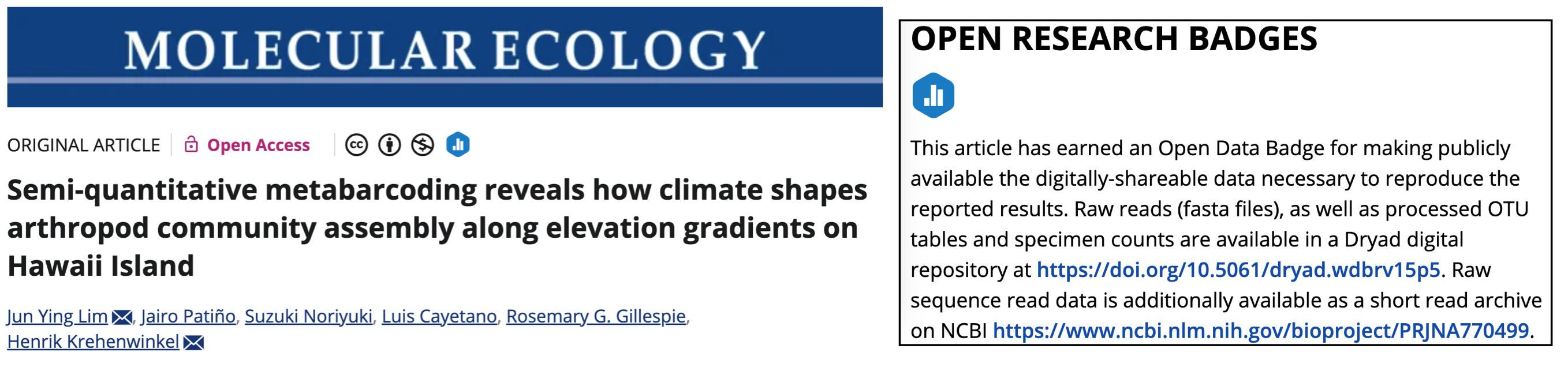
Another goal is for journals to clearly indicate CARE metadata. Journals are adopting visible badges relating to FAIR (Kidwell et al. 2016), but not to CARE. For example this paper (Lim et al. 2021) based on data from Hawaiʻi prominently displays an “Open Data Badge” above the title, defining the badge later in the article.
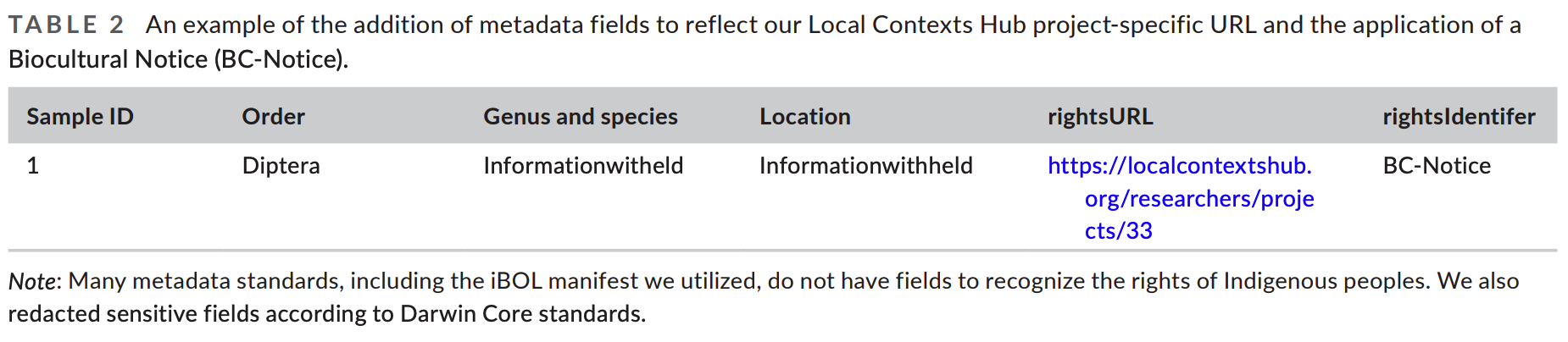
Another article centering CARE practices in a closely related journal using the same publishing platform, including overlapping authors, using data from within the same mokupuni, is not able to display Local Contexts Notices on equal footing with FAIR-related badges. Instead, Notices are displayed in data figures (the best solution available). But if Labels were to replace these Notices, the static figure would not reflect that update, whereas dynamic badges rendered by the journal itself would be able to.
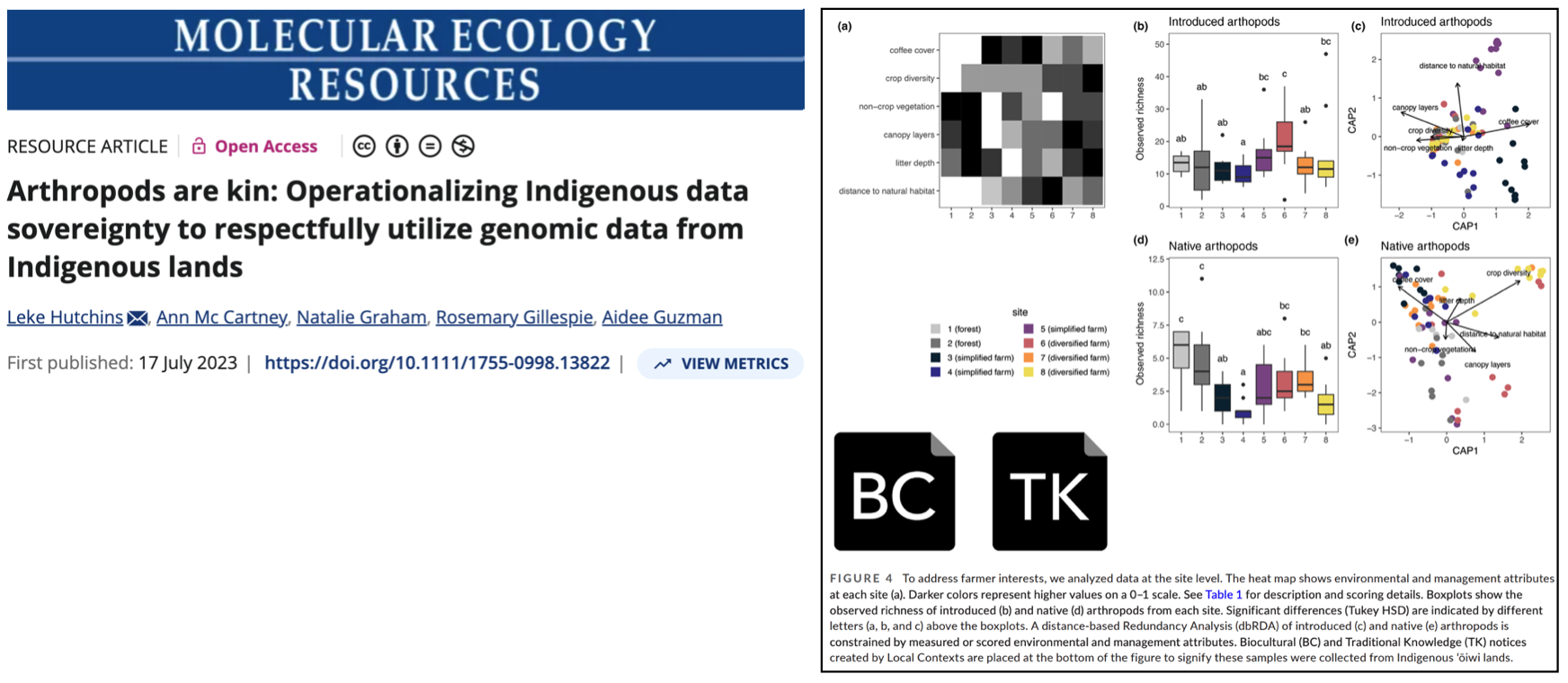
The article by Leke Hutchins and colleagues (2023) also does not earn an Open Data Badge despite metadata conforming to open standards and residing in BOLD, a FAIR repository, and the data itself residing in the Native BioData Consortium and reusable within conditions mandated by CARE.
Hawaiʻi contains a multitude of active work involving IDSov and IDGov. Among many examples, see the Paoakalani Declaration (2021), the Huamakahikina Declaration (2021), the Kūlana Noiʻi, work by the Ahupauʻa Accelerator Initiative (see “Information and Data Management, Storage, and Sharing” in their Ahupuaʻa Action Agenda), and work and advocacy by Rosie ʻAnolani Alegado (e.g. here) among many more. Among these efforts and initiatives is the critical work of organizing communities to identify authorized representatives and create decision making structures so that Labels (or another articulation of CARE metadata) can be applied to data. Currently (as of December 2025) such authorized bodies may not exist for most data stewardship scenarios, for example the data in Hutchins et al. (2023).
The work of advancing IDSov and IDGov in Hawaiʻi is rooted in correcting and healing the violence against and violations of human rights and Indigenous rights perpetrated against the Kanaka1 ʻŌiwi by European and American colonizers from first European contact, through the US-backed illegal overthrow, through illegal US annexation, to the present. Settler colonialism is why there is an absence of authorized bodies to articulate Indigenous rights and interests in data, let alone other aspects of wellbeing and self-determination. The research apparatus, including the University of Hawaiʻi, and scientific racism were and remain integral parts of Euro-American settler colonialism (Trask 1993; Kauai & Balutski 2024). Therefore, academic research in Hawaiʻi holds a distinct kuleana to confront and correct continued colonial practices and kākoʻo the Kanaka ʻŌiwi right to ea and self-determination.
2.5 CARE and FAIR for this class
Our class uses data already collected/compiled and published by other researchers (Craven et al. 2018; Craven 2019; McLean et al. 2023). These data have been published in compliance with FAIR. FAIR compliance takes the form of:
- Findable: within their respective databases, metadata can be searched to located the intended data and data have DOIs or other permanent identifiers. For convenience, we use copies of these data for this class, so we will not directly engage with the databases themselves.
- Accessible: the data can be downloaded through HTTP or via API using open protocols and the data are stored in open formats
- Interoperable: metadata (see tables in the previous chapter) clearly define all data fields allowing data to be merged or integrated into other workflows
- Reusable: the data are licenced under open licences allowing reuse
However, none of the data are CARE compliant. That leaves us with the question of what to do? There are a series of compromises to consider:
- Centering place-based ecosystems and data in a class situated in Hawaiʻi honors this place and our connection to it
- But: working with non-CARE-complying data that are already collected and published means we have no control over how the data were collected and limited impact on how their re-use is governed
- Our limited impact can include reflecting on our own use of the data and identifying ways our individual use can align with CARE
- But: our individual respect for CARE does not correct the larger problem of non-CARE-complying data being published
- Our limited impact can extend a little further if we collaborate in this class to articulate a vision for how these data could meet the CARE principles
- But: that vision may not be achievable
We will proceed in working with these data but our first assignment for this course will be drafting our considerations for respecting CARE individually and drafting ideas for a proposal to make the official stewardship of the data CARE-compliant.
2.6 Slides
2.7 References
Carroll S et al. 2020. The CARE principles for indigenous data governance. Data science journal 19. Ubiquity Press.
Carroll SR, Herczog E, Hudson M, Russell K, Stall S. 2021. Operationalizing the CARE and FAIR principles for indigenous data futures. Scientific data 8:108. Nature Publishing Group UK London.
Chen CY, Kahanamoku SS, Tripati A, Alegado RA, Morris VR, Andrade K, Hosbey J. 2022. Systemic racial disparities in funding rates at the national science foundation. Elife 11:e83071. eLife Sciences Publications, Ltd.
Craven D. 2019, June. Dylancraven/hawaii_diversity: beta. Zenodo. Available from https://doi.org/10.5281/zenodo.3250638.
Craven D, Knight TM, Barton KE, Bialic-Murphy L, Cordell S, Giardina CP, Gillespie TW, Ostertag R, Sack L, Chase JM. 2018. OpenNahele: The open hawaiian forest plot database. Biodiversity Data Journal:e28406.
Filazzola A, Cahill Jr JF. 2021. Replication in field ecology: Identifying challenges and proposing solutions. Methods in Ecology and Evolution 12:1780–1792. Wiley Online Library.
GIDA. 2019. Research Data Alliance International Indigenous Data Sovereignty Interest Group. CARE Principles for Indigenous Data Governance. https://www.gida-global.org/care.
Huamakahikina. 2021. Huamakahikina declaration. https://nativehawaiianlegalcorp.org/wp-content/uploads/2024/06/Huamakahikina_Declaration_2021.pdf.
Hutchins L, Mc Cartney A, Graham N, Gillespie R, Guzman A. 2023. Arthropods are kin: Operationalizing indigenous data sovereignty to respectfully utilize genomic data from indigenous lands. Molecular Ecology Resources 25:e13822. Wiley Online Library.
Kauai W, Balutski BJN. 2024. A hawaiian place of learning under US occupation. Journal Committed to Social Change on Race and Ethnicity (JCSCORE) 10:113–129. JSTOR.
Kauanui JK. 2008. Colonialism in equality: Hawaiian sovereignty and the question of US civil rights. South Atlantic Quarterly 107:635–650. Duke University Press.
Kidwell MC et al. 2016. Badges to acknowledge open practices: A simple, low-cost, effective method for increasing transparency. PLoS biology 14:e1002456. Public Library of Science San Francisco, CA USA.
Kukutai T, Taylor J. 2016. Indigenous data sovereignty: Toward an agenda. ANU press.
Larregue J, Nielsen MW. 2024. Knowledge hierarchies and gender disparities in social science funding. Sociology 58:45–65. SAGE Publications Sage UK: London, England.
Lim JY, Patiño J, Noriyuki S, Cayetano L, Gillespie RG, Krehenwinkel H. 2021. Semi-quantitative metabarcoding reveals how climate shapes arthropod community assembly along elevation gradients on hawaii island. Molecular Ecology 31:1416–1429. Wiley Online Library.
Local Contexts. 2025a. Local contexts labels. https://localcontexts.org/labels/about-the-labels/.
Local Contexts. 2025b. Local contexts notices. https://localcontexts.org/notices/about-the-notices/.
Ma A, Mondragón RJ, Latora V. 2015. Anatomy of funded research in science. Proceedings of the National Academy of Sciences 112:14760–14765. National Academy of Sciences.
Maglia A. 2015. NSF data management and public access initiatives.
McLean J, Cleveland SB, Dodge M, Lucas MP, Longman RJ, Giambelluca TW, Jacobs GA. 2023. Building a portal for climate data—mapping automation, visualization, and dissemination. Concurrency and Computation: Practice and Experience 35:e6727. Wiley Online Library.
Nguyen M, Gonzalez L, Chaudhry SI, Ahuja N, Pomahac B, Newman A, Cannon A, Zarebski SA, Dardik A, Boatright D. 2023. Gender disparity in national institutes of health funding among surgeon-scientists from 1995 to 2020. JAMA network open 6:e233630–e233630. American Medical Association.
Nosek BA et al. 2015. Promoting an open research culture. Science 348:1422–1425. American Association for the Advancement of Science.
Paoakalani Declaration. 2021. https://nativehawaiianlegalcorp.org/wp-content/uploads/2024/06/Paoakalani-Declaration.pdf.
Parker TH, Forstmeier W, Koricheva J, Fidler F, Hadfield JD, Chee YE, Kelly CD, Gurevitch J, Nakagawa S. 2016. Transparency in ecology and evolution: Real problems, real solutions. Trends in Ecology & Evolution 31:711–719. Elsevier.
Petersen OH. 2021. Inequality of research funding between different countries and regions is a serious problem for global science. Function 2:zqab060. Oxford University Press.
Stebbins M. 2013. Expanding public access to the results of federally funded research.
Trask H-K. 1993. From a native daughter: Colonialism and sovereignty in hawaii (revised edition). University of Hawaii Press.
UN General Assembly. 2007. United nations declaration on the rights of indigenous peoples 12:1–18.
Wilkinson MD et al. 2016. The FAIR guiding principles for scientific data management and stewardship. Scientific data 3:1–9. Nature Publishing Group.